
Reviewed · IMPERIAL CITY TOURS
Hue Imperial City and Forbidden City Walking Private Tour
Hue’s Imperial City is much easier to understand when someone explains what each gate, hall, garden, and bronze urn was built to do. This private walk takes you from the Nine Holy Cannons and Flag Tower through the royal compound, linking 143 years of Nguyen Dynasty rule to the buildings in front of you.
I like the private format, which lets you ask questions and set a comfortable pace, and I like the focus on places many short visits rush past, including Thiệu Phương Garden and Duyet Thi Duong Theater. The main drawback is time: 150 minutes covers a lot, so some stops are brief and the 200,000 VND entrance ticket is extra.
In This Review
- Key points at a glance
- Why a private walk helps inside Hue’s citadel
- Meeting the guide by the bronze cannons
- From the Flag Tower to Ngo Mon Gate
- Thai Hoa Palace and the royal court
- Entering the Forbidden Purple City
- Thiệu Phương Garden and Thai Binh Pavilion
- Kien Trung Palace and the story of reconstruction
- The Queen Mother’s residence and the Nguyen memorial zone
- What the $23 price really covers
- Pace, weather, and guide quality
- Who should book this Hue Imperial City tour
- FAQ
- How long does the Hue Imperial City walking tour last?
- What time does the tour start?
- Is this a private tour?
- Where do I meet the guide?
- Is the Imperial City entrance ticket included?
- Are hotel pickup and drop-off included?
- What language is the tour conducted in?
- Does the price include food and drinks?
- Where does the tour finish?
- Should you book it?
Key points at a glance
- See the 1833 Noon Gate and Ngu Phung Pavilion, the grand ceremonial entrance to the Imperial City.
- Learn how 13 Nguyen kings used Thai Hoa Palace for coronations and court ceremonies.
- Walk through the Forbidden Purple City, once reserved for the emperor and royal family.
- Visit the restored Kien Trung Palace, rebuilt in 2024 after its earlier collapse.
- Explore royal spaces often missed on quick visits, including Thiệu Phương Garden, Thai Binh Pavilion, and Duyet Thi Duong Theater.
- Travel with a private English-speaking guide for $23 per person, with water included and hotel transport available if you select that option.
Why a private walk helps inside Hue’s citadel
Hue’s Imperial City is not one single building. It is a large walled complex with ceremonial gates, audience halls, family residences, gardens, temples, theaters, and courtyards. Without context, you may see attractive roofs and fading walls without knowing who could enter, what ceremonies took place, or why one building mattered more than another.
That is where this tour earns its keep. Your guide explains the Nguyen Dynasty, which ruled Vietnam for 143 years, while you move through the court’s former public and private zones. The best guides also connect architecture to people and power, such as the difference between a gate used by the king and one used by ordinary court officials.
The private setup suits anyone who wants to ask direct questions. Guides named Austin, Ha, Anna, Nhi, Duyen, Quan, Daniel, Long, and others have been praised for clear explanations, friendly conversation, and help beyond the basic route. Austin has been especially good at making complicated court history easy to follow, while Ha has been noted for answering questions about Hue’s culture as well as the citadel.
You should still keep your expectations realistic. This is a walking history tour, not a leisurely half-day stroll with long breaks. The listed stops add up to a busy route, and some visits are planned for only 10 minutes. If you want detailed photography at every courtyard, you may need extra time after the tour.
More City Tours in Hue
- Hue Customizable Tour with Imperial Citadel & Forbidden City
★ 4.9 · 937 reviews - Hue :Exploring Royal City with Multi Options and Dragon Boat
★ 5.0 · 675 reviews - Hue City Tour Full Day – Group Tour
★ 4.7 · 518 reviews
Meeting the guide by the bronze cannons
The meeting point is near the Ngan Gate, at the area of the four bronze cannons, where your guide waits with an A4 sheet showing your name. The tour information also refers to the Nine Holy Cannons, or Cửu vị thần công. To avoid a needless search, confirm the exact meeting spot and gate name before setting out, especially if you are arranging your own way there.
The cannons were cast in 1803 and are among the early Nguyen Dynasty objects you encounter. They are not simply old weapons. Their presence helps introduce the dynasty’s ambition to create a new imperial capital after the political upheavals that preceded Nguyen rule.
If you choose the hotel pickup and drop-off option, transport is included. Otherwise, you meet at the stated starting point. The walk finishes at Cua Hien Nhon, so you should plan your next stop from there rather than assume you return to the cannons.
From the Flag Tower to Ngo Mon Gate
The first major stop is Hue’s Flag Tower, or Kỳ Đài. Built on the south side of the citadel, it served as the royal court’s flag-bearing site. The tower gives you an immediate sense of the Imperial City as a carefully ordered seat of power, with the flag visible from far beyond the palace buildings.
The stop is scheduled for about 10 minutes. That is enough for an introduction and photographs, but not a long architectural study. I would listen closely here because the guide’s explanation helps you read the rest of the complex as a royal capital rather than a collection of separate monuments.
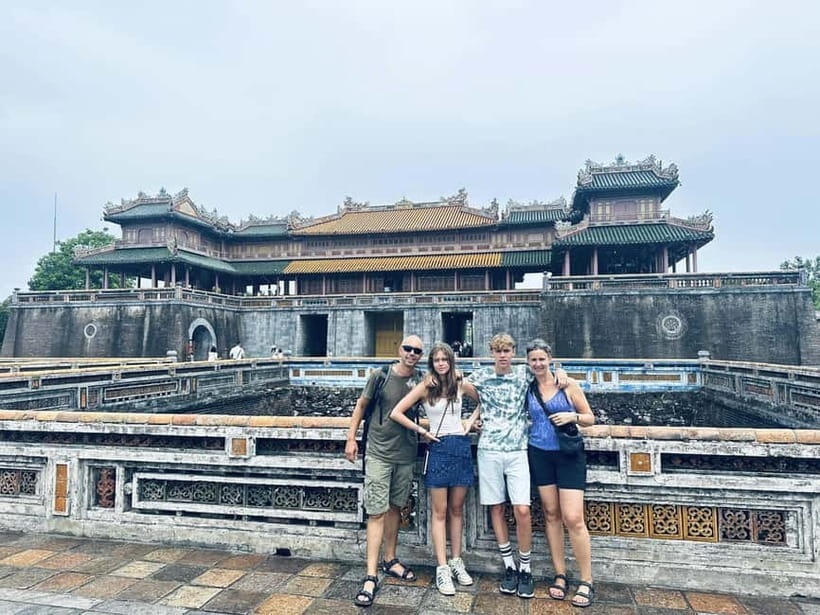
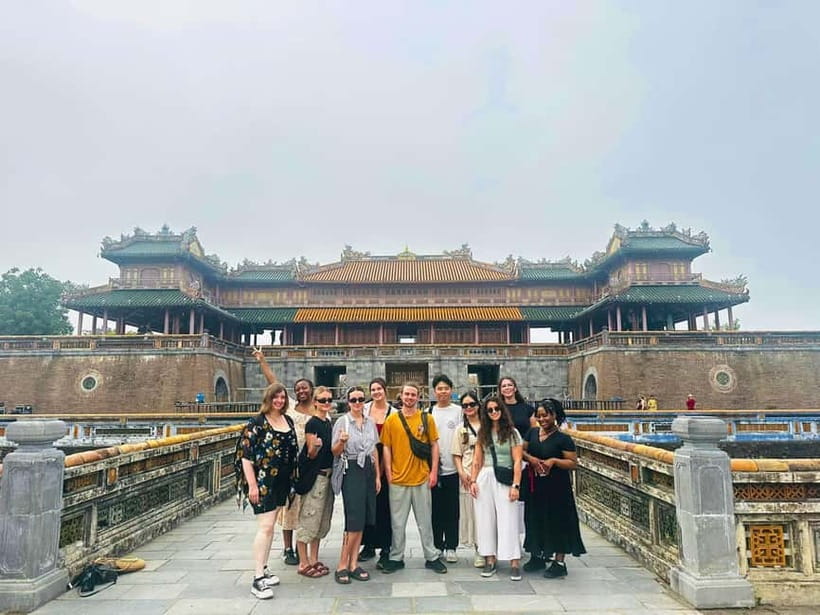
Next comes Cua Ngo Mon, better known as the Noon Gate. Built in 1833, it was reserved for the king and used to receive envoys. The name can sound like a simple time reference, but the gate’s real importance is ceremonial. Passing through it meant entering the most protected part of the court.
Above the gate is Ngu Phung Pavilion, a striking ironwood structure supported by 100 pillars. The pavilion’s layered form and position above the gate make it one of the most recognizable views in Hue. Your 10-minute visit includes a guided explanation and time to walk and take photographs.
Thai Hoa Palace and the royal court
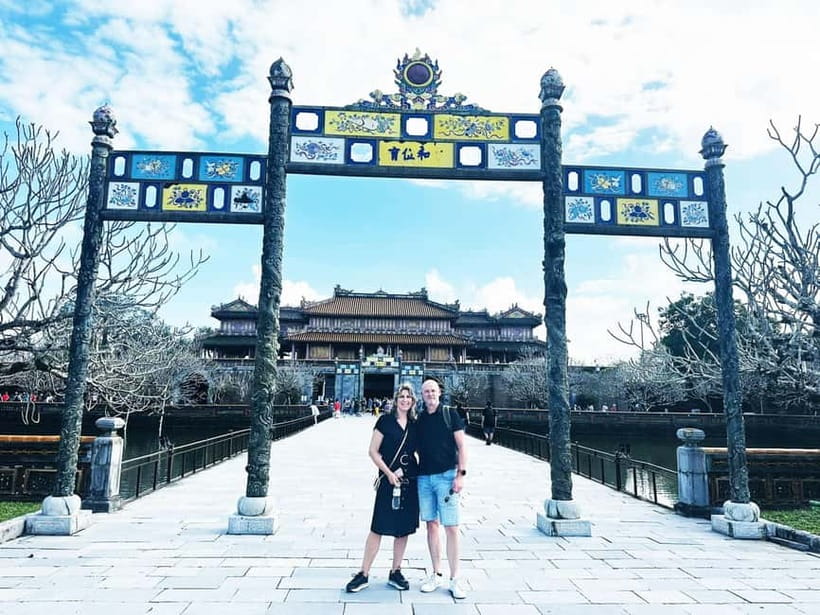
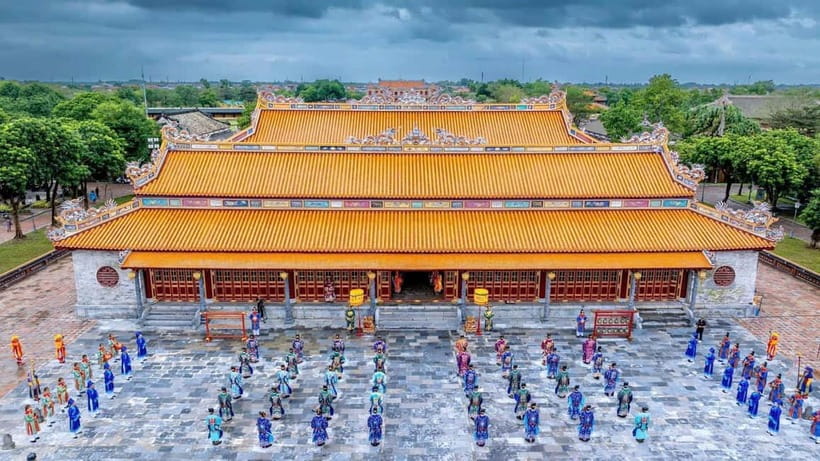
Thai Hoa Palace is one of the essential stops because it was the coronation site of all 13 Nguyen kings. Its role was public and formal, unlike the restricted spaces farther inside. Here, the architecture helped stage royal authority through ceremony, rank, and controlled access.
The tour allows about 15 minutes at the palace. That is a useful amount of time for the main story and photographs, though you may want to return later if the interiors and decorative details hold your attention.
The broader Imperial City visit follows. This is where your guide can explain the layout of the royal compound and the difference between the outer citadel, the Imperial City, and the Forbidden Purple City. I appreciate this part because the names can blur together when you explore alone.
The Nguyen court was not open to everyone. Access depended on position, gender, duty, and relationship to the emperor. A guide helps you understand those boundaries instead of treating every courtyard as an interchangeable photo stop.
More Walking Tours in Hue
- Hue Imperial Ancient City Walking Tour
★ 4.8 · 308 reviews - Eat like a local with a local – Walking Tour
★ 4.9 · 57 reviews - Hue Imperial city walking tour and optional royal tombs
★ 4.7 · 19 reviews - Hue: Imperial City Walk, Motorbike Tour & Private Car Options
★ 5.0 · 732 reviews
Entering the Forbidden Purple City
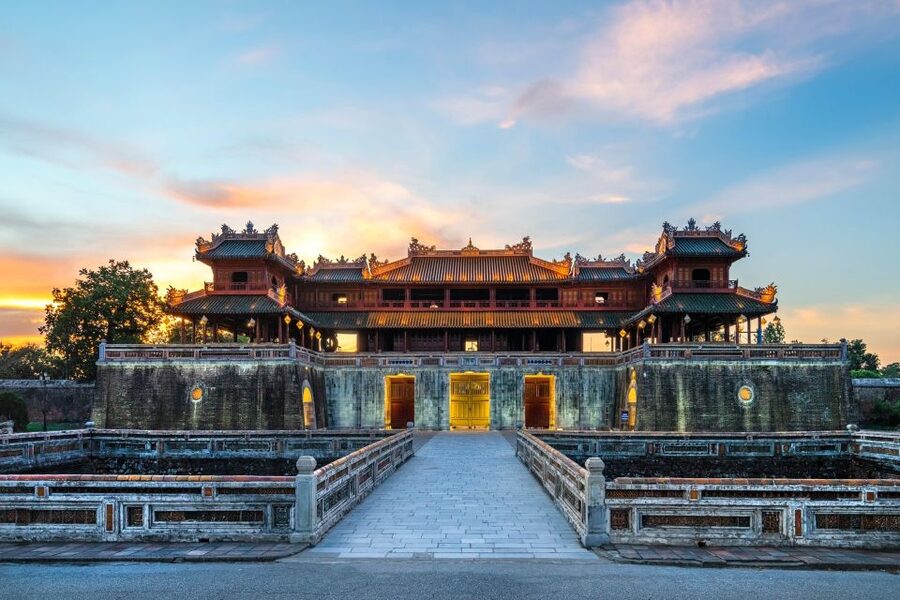
The Forbidden Purple City, or Tử Cấm Thành, was reserved for the emperor and royal family. Mandarins and civilians were not permitted to come close. This restriction makes the area important even when some structures are incomplete or reconstructed.
You will hear about the people who lived and worked here, and about the court system that kept the king’s private world separate from the public business of government. The site is best understood through these human details. Empty foundations and restored buildings make more sense when you know who once had the right to enter them.
The route includes Duyet Thi Duong Royal Theater, one of four theaters built under the Nguyen Dynasty and the oldest surviving theater of the group. It was a place for royal performances, not a public venue in the modern sense.
The theater stop lasts about 10 minutes. It adds welcome variety to a route otherwise dominated by gates, halls, and temples. Ask your guide about how performances fit into court life, since this building shows that royal culture involved music and theater as well as ceremonies and administration.
Thiệu Phương Garden and Thai Binh Pavilion
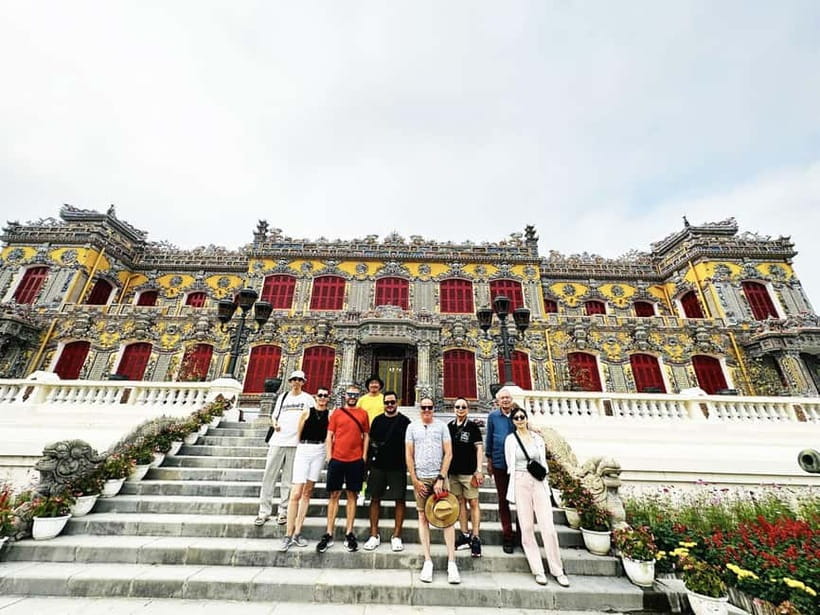
Thiệu Phương Garden was built in 1828 and is one of the notable royal gardens from the Nguyen period. A garden like this was not just decoration. It gave the court a controlled setting for rest, viewing, and private moments within the palace compound.
The garden visit is scheduled for 10 minutes. That makes it an introduction rather than a slow garden walk, but it is still one of the stops that gives the itinerary a more personal feel. After the formal gates and palace halls, you see how the royal family used space for quiet time.
Thai Binh Pavilion was built between 1919 and 1921 as a place for the king to rest and relax. Its function helps you picture the later Nguyen court in more ordinary terms. Even emperors needed rooms away from ceremonies, officials, and formal audiences.
You get about 15 minutes here. The extra time compared with some other stops gives your guide room to explain the building’s purpose and lets you take in the setting. If you prefer architecture and court life over military history, these two stops may be among your favorites.
Kien Trung Palace and the story of reconstruction
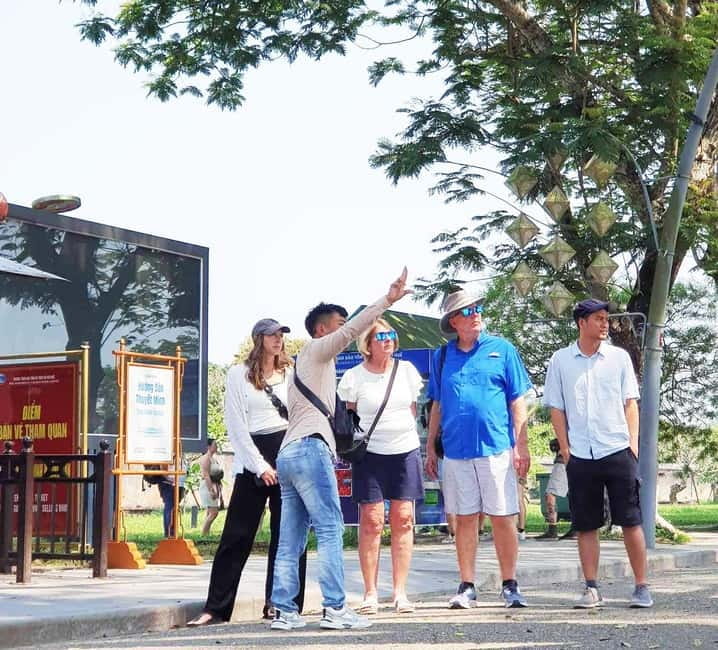
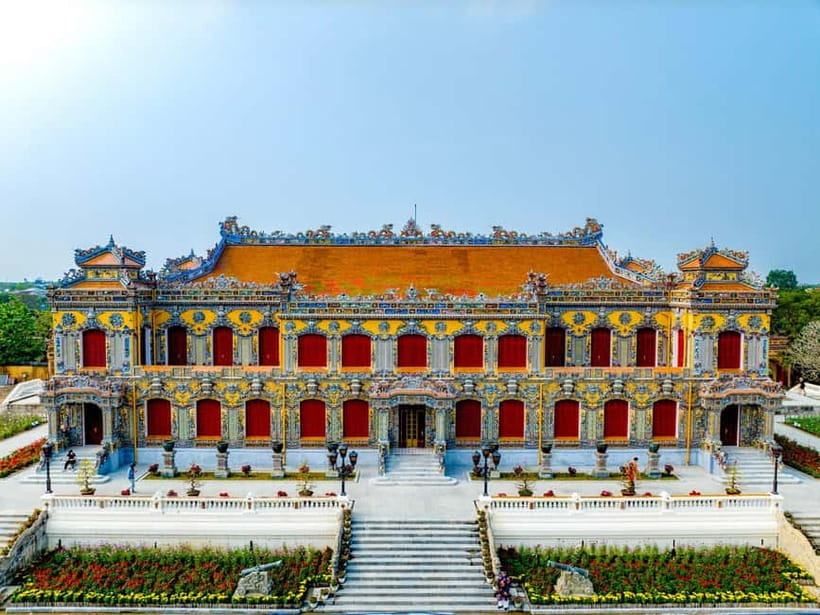
Kien Trung Palace was built in 1923 and combined Asian and European architectural ideas. That blend reflects the changing world of the final Nguyen period, when traditional imperial forms existed alongside outside influences.
The palace completely collapsed before being rebuilt in 2024. Its restoration gives you a chance to see a major palace returned to the Imperial City, but it also means you should distinguish between original survival and modern reconstruction. The restored building is visually impressive, yet the guide’s historical explanation matters because the structure you see today is not untouched.
The tour gives Kien Trung Palace 15 minutes. That is enough for a clear introduction and photographs. If you care about restoration, ask how the rebuilding affects the way the site should be read. A good guide can help separate original materials, historical design, and present-day repair.
The Queen Mother’s residence and the Nguyen memorial zone
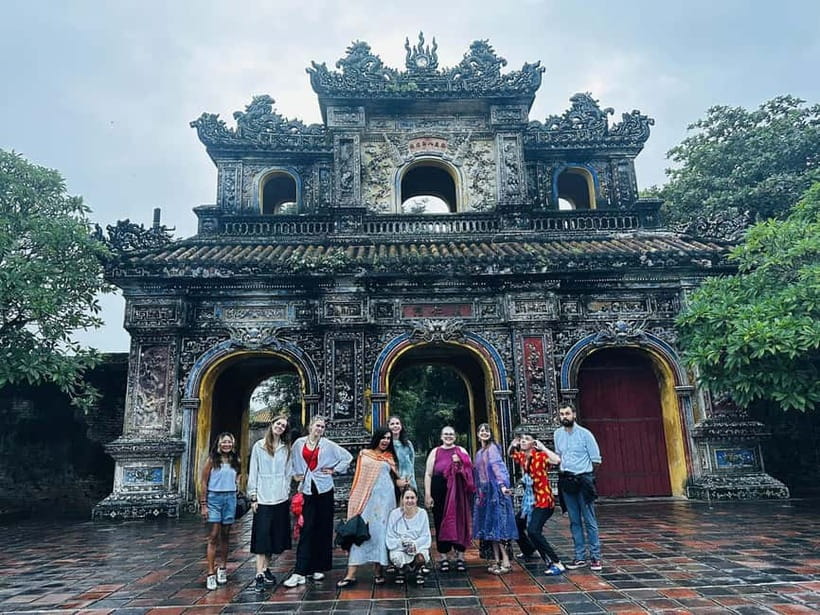
Dien Tho Palace was the residence of the Queen Mother. It has a large scale, carved details, and a refined style. This stop adds an important layer to the story because the Imperial City was not only organized around the emperor. Senior royal women had their own residences, authority, and protected spaces.
The route then moves toward Hung To Mieu, the Mieu Temple, the Nine Dynastic Urns, and Hien Lam Pavilion. The Mieu Temple is dedicated to 10 Nguyen kings and served as a place of dynastic worship. It shifts the focus from the living court to the family line the dynasty wanted future generations to honor.
The Nine Dynastic Urns were commissioned by Emperor Minh Mang in 1835. Across the nine bronze urns, 162 images were cast and carved. They are more than large ceremonial objects. Their images represent the natural and cultural world claimed by the dynasty, while the urns themselves honor the emperors and the continuity of the royal house.
Hien Lam Pavilion was built between 1821 and 1822. It is described as a place where emperors had their epiphanies, and it completes the route with a monument tied to royal reflection and memory. The final stretch is especially useful if you want to understand how Nguyen rulers presented their own legacy.
The tour ends at Cua Hien Nhon. From there, you can continue exploring the Hue Imperial City area on your own, but the guided portion has already given you a framework for the remaining buildings.
What the $23 price really covers
At $23 per person, the tour is a strong value for a private 2 to 2.5-hour walk, particularly for couples, families, or small groups who would otherwise pay for a private guide separately. The price includes an English-speaking guide, bottled water, and the guided visit itself.
You must pay the Imperial City entrance fee separately: 200,000 VND per adult. The guide can help you buy the ticket, and carrying cash in Vietnamese dong should save time at the counter. Combo tickets may cost less if you also plan to visit royal tombs: 420,000 VND for the Imperial City and two tombs, or 530,000 VND for the Imperial City and three tombs, valid for two days.
Those combo options matter if Hue is part of a longer sightseeing plan. If you only want the citadel, the single ticket is simpler. If you already know you will visit several tombs, compare the total before buying.
Food and drinks are not included, but bottled water is. Hotel pickup and drop-off depend on the option you select, so check that detail before paying. The tour offers free cancellation up to 24 hours before the start and lets you reserve now and pay later, which helps if your Hue schedule is still shifting.
Pace, weather, and guide quality
Hue can be hot, wet, or both, and much of this experience takes place outdoors between buildings. Comfortable walking shoes and sun or rain protection are sensible choices. One guide, Anna, arrived with a poncho and helmet during heavy rain, which shows the sort of practical care you may value when weather turns poor, though you should still bring your own protection.
The strongest part of the experience is the guide. Austin has been praised for making the history easy to grasp and for answering questions. Ha is known for a relaxed pace and clear explanations. Nhi, Duyen, Quan, Daniel, and Long have also been singled out for warmth, patience, and solid command of Hue’s past.
Communication before the tour has also been prompt in several cases, including last-minute arrangements. Still, one person found the guide’s English hard to understand at times. That is a fair consideration for anyone who needs very precise spoken explanations. The experience is rated 4.9 from 42 bookings, but guide quality can vary by individual, so use the guide’s name and your needs when confirming.
Who should book this Hue Imperial City tour
I would choose this tour if you have limited time in Hue, want the main Imperial City story in one visit, or prefer asking questions instead of reading signs. It is also a good fit if you care about the later Nguyen period, restoration, royal women’s residences, gardens, and theater as much as the famous gate and palace.
Families may appreciate the private format because you can pause for questions and keep the walk focused. History fans will get the most from the succession of ceremonial, residential, religious, and cultural buildings. First-time visitors benefit from having the complex explained in a sensible order.
I would hesitate only if you want a slow, unstructured photo walk or plan to spend half a day inside each palace. The schedule is full, and the short stops favor a clear overview. You can always stay afterward and revisit the places that caught your eye.
FAQ
How long does the Hue Imperial City walking tour last?
The tour lasts between two and two and a half hours, with the stated duration listed as 150 minutes.
What time does the tour start?
The start time depends on your requirements and the selected option. Availability should be checked when booking.
Is this a private tour?
Yes. The tour is for a private group with a live English-speaking guide.
Where do I meet the guide?
The guide waits near the four bronze cannons by Ngan Gate, or Cua Ngan, holding an A4 paper with your name. The tour information also refers to the Nine Holy Cannons, so confirm the precise meeting location before arrival.
Is the Imperial City entrance ticket included?
No. The entrance ticket costs 200,000 VND per adult and is paid separately. The guide can assist you with buying it.
Are hotel pickup and drop-off included?
Hotel pickup and drop-off are included only if you select that option.
What language is the tour conducted in?
The tour is conducted in English.
Does the price include food and drinks?
Food and drinks are not included. Bottled water is included.
Where does the tour finish?
The walking tour finishes at Cua Hien Nhon.
Should you book it?
Book this tour if you want Hue’s Imperial City to make sense, not just look impressive. The private guide, focused route, and $23 price give you useful historical context across the main gates, palaces, gardens, theater, temple, urns, and restored Kien Trung Palace.
Skip it if you prefer exploring entirely alone or need long, leisurely stops for photography. For most visitors with only a few hours in Hue, though, this is a practical way to see the royal compound and understand the Nguyen Dynasty before continuing to the city’s tombs or other sights.
More Walking Tours in Hue Vietnam
- Private Street Food Evening Walking Tour in Ho Chi Minh City
★ 5.0 · 3,175 reviews - [HOT] Hanoi Old Quarter Walking Street Food – Small Group Tour
★ 5.0 · 2,163 reviews - Super Niche Walking Street Food Tour in Ho Chi Minh City
★ 5.0 · 1,636 reviews - Private Walking Tour of Hanoi City
★ 5.0 · 1,251 reviews
Recently reviewed around Hue Vietnam
- Phong Nha National Park: Paradise Cave Half-Day Tour★ 5.0 · 23 reviews
- Official Hue: Dragon Boat, Imperial Citadel, & Market tour★ 4.7 · 32 reviews
- Hue to Hoi An/Da Nang: Private Scenic Motorbike Tour★ 4.9 · 63 reviews
- Hue: Royal Tombs Private Tour with 3 Best Tombs & Pagoda★ 4.9 · 213 reviews
- Hue: Private Transfer to/from Hoi An via Sightseeing Stops★ 4.9 · 111 reviews
- Hue Royal Tombs Tour: Visit Best Pagodas & Mausoleums★ 4.9 · 19 reviews
- Hue : Private Day Trip to DMZ : Vinh Moc tunnel & Khe Sanh★ 5.0 · 26 reviews
- Hue to Hoi An by bus: Hai Van Pass, Lang Co, Marble mountain★ 4.6 · 27 reviews
Imperial City Tours, compared.
Hue Customizable Tour with Imperial Citadel & Forbidden City
Read our review →
Imperial City, Hue: Day Tour from Hoi An and Da Nang
Read our review →
Da Nang/Hoi An: Hue Imperial City via Hai Van Pass & Lunch
Read our review →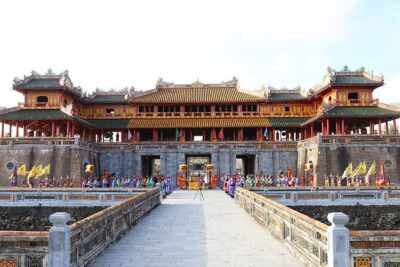
Imperial City Walk, Motorbike Tour & Private Car Options
Read our review →
Hue City and The Citadel via Hai Van Pass Daily Small Group Tour
Read our review →
Hue Citadel tour by authentic Train via Hai Van Pass from Da Nang
Read our review →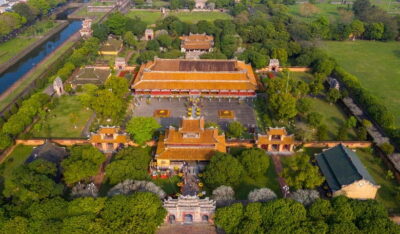
From Da Nang/Hoian/Hue: Hue Imperial City Full-Day Tour
Read our review →
Hue Imperial City Walking Tour: Citadel & Forbidden City
Read our review →Browse the lists this tour appears in