
Reviewed · HUE TOURS
Hue Royal Tombs Tour: Visit Best Pagodas & Mausoleums
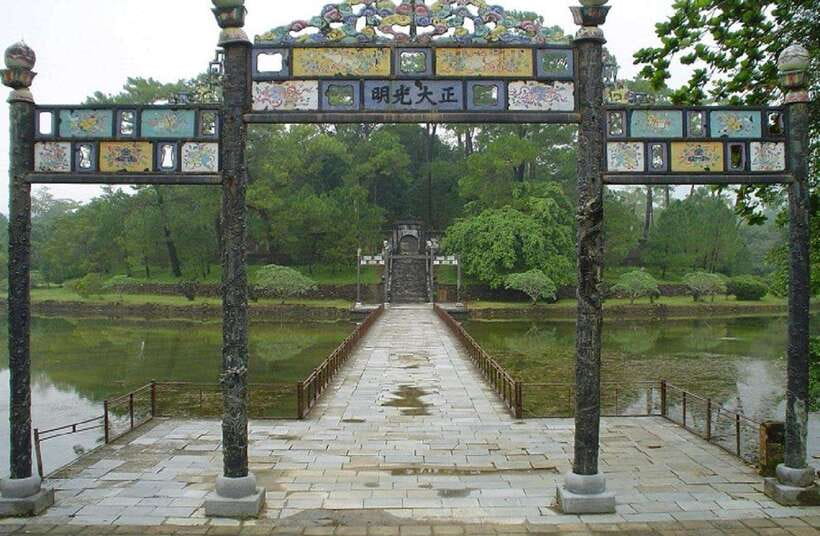
Hue’s royal tombs are not simple graves. They are grand retreat grounds, temple compounds, and carefully staged statements about each emperor’s character. This private-car tour lets you compare Tu Duc’s quiet, personal retreat with Khai Dinh’s ornate blend of Vietnamese and European design, then add pagodas and lesser-visited mausoleums to suit your day.
I like the freedom to set your own route, and I like having a driver for sites spread across the countryside around Hue. Guides such as Bi, Ba, David, Duy, and Tra My have led past bookings, with Bi noted for helpful local tips and Duy for allowing plenty of time at each stop. The main catch is that the $15 price does not include entrance tickets, and the full list of seven sites would be far too much for a rushed two-hour outing.
In This Review
- Key points to know before booking
- Why Hue’s tombs deserve a full day
- Tu Duc Tomb: a royal retreat with a personal feel
- Minh Mang Tomb: the most formal royal plan
- Khai Dinh Tomb: compact, steep, and richly decorated
- Gia Long Tomb: space, distance, and a quieter visit
- Dong Khanh Tomb: a smaller complex with two distinct zones
- Thien Mu Pagoda: Hue’s best-known religious landmark
- Tu Hieu Pagoda: a quieter connection to modern Buddhist life
- How the private car changes the day
- What the $15 price really covers
- Guides and the value of local explanation
- Who should book this Hue tour?
- Should you book the Hue Royal Tombs Tour?
- FAQ
- Where does the tour pick me up?
- Does the tour return to my hotel?
- Is transportation private?
- Is an English-speaking guide included?
- Which royal tombs can I visit?
- Are entrance tickets included?
- Are food and drinks included?
- Can I cancel or pay later?
Key points to know before booking
- Choose your own royal-tomb mix: Focus on Tu Duc, Minh Mang, and Khai Dinh, or add Gia Long and Dong Khanh for a longer day.
- Private transport saves time: The tombs are spread out, so a car is far easier than piecing together separate rides.
- The best-known trio is Tu Duc, Minh Mang, and Khai Dinh: These give you the clearest contrast in architecture and royal life.
- Pagodas add a living spiritual side: Thien Mu and Tu Hieu show why Buddhism remains important in Hue.
- Entrance fees are extra: Budget 150,000 Vietnamese dong per tomb, or consider the two-day combination tickets.
- The guide can make the difference: English-speaking guides explain royal families, concubines, eunuchs, and local customs beyond what you see on the signs.
Why Hue’s tombs deserve a full day

The Nguyen emperors ruled Vietnam from Hue, and their tombs were built as more than final resting places. Each complex includes paths, courtyards, gates, temples, and burial grounds. Some rulers planned their mausoleums while still alive, using them as places to work, rest, and hold court.
That makes the tombs feel different from one another. Tu Duc’s site reflects an emperor who spent time there during his lifetime. Minh Mang’s complex follows a formal plan with a strong sense of order. Khai Dinh’s mausoleum is compact, steep, and highly decorated.
I find this comparison to be the heart of the outing. You are not just ticking off monuments. You are seeing how architecture expresses royal power, personal taste, family life, and the changing direction of Vietnam.
The private format helps here. You can spend longer at a place that catches your eye, take photos without being hurried along, or shorten a stop if the heat sets in. Since the sites sit apart from one another, the drive between them also gives your guide time to point out other old places along the road.
Other Hue Vietnam days travellers weigh against this one:
- Hue Customizable Tour with Imperial Citadel & Forbidden City
★ 4.9 · 937 reviews - Hue :Exploring Royal City with Multi Options and Dragon Boat
★ 5.0 · 675 reviews - Hue City Tour Full Day – Group Tour
★ 4.7 · 518 reviews
Tu Duc Tomb: a royal retreat with a personal feel
Tu Duc Tomb is a strong first stop because it gives you a sense of the emperor as a living person. Construction took place from 1864 to 1867, and Tu Duc used the site while he was alive. It contains both a temple area and a burial area, spread across roughly 12 hectares.
Rather than feeling like a single monument, the complex works as a large estate. Pavilions, courtyards, water, and gardens helped create a place for work and rest. Your guide can explain how the site related to Tu Duc’s wives, concubines, and eunuchs, including the fact that some remained there after his death in 1883.
Allow about 45 minutes for this stop in the suggested plan. That is enough for a useful introduction and photographs, but you may want longer if you enjoy gardens and quiet corners. The grounds can involve walking, so comfortable shoes matter.
Tu Duc is also one of the better places to hear about the less polished side of palace life. The story is not only about an emperor’s monuments. It also includes the people who served him and the women whose lives were tied to the court.
Minh Mang Tomb: the most formal royal plan
Minh Mang Tomb covers about 15 hectares and includes 26 buildings for different purposes. Construction began in 1840, when Minh Mang started the project for himself. He died before it was complete, and his son, King Thieu Tri, finished it between 1840 and 1843.
The complex has a more ordered feel than Tu Duc’s retreat. The buildings and spaces create a clear progression, with the royal setting revealed in stages as you walk. This is a place where the layout matters as much as any one gate or pavilion.
The site also reveals the practical arrangements of royal households. After Minh Mang’s death, it served as a residence for minor wives and concubines who had no children with him, along with eunuchs. That detail gives the mausoleum a human scale, even amid its formal design.
Plan on roughly 45 minutes here. I would not cut this stop too short, since the sequence of courtyards and buildings is part of the experience. If you are choosing only three tombs, Minh Mang belongs on the shortlist.
Khai Dinh Tomb: compact, steep, and richly decorated

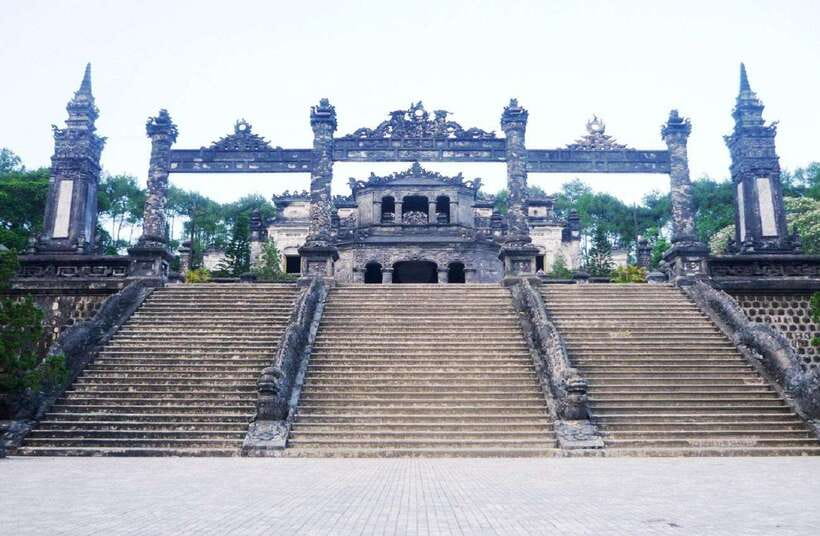
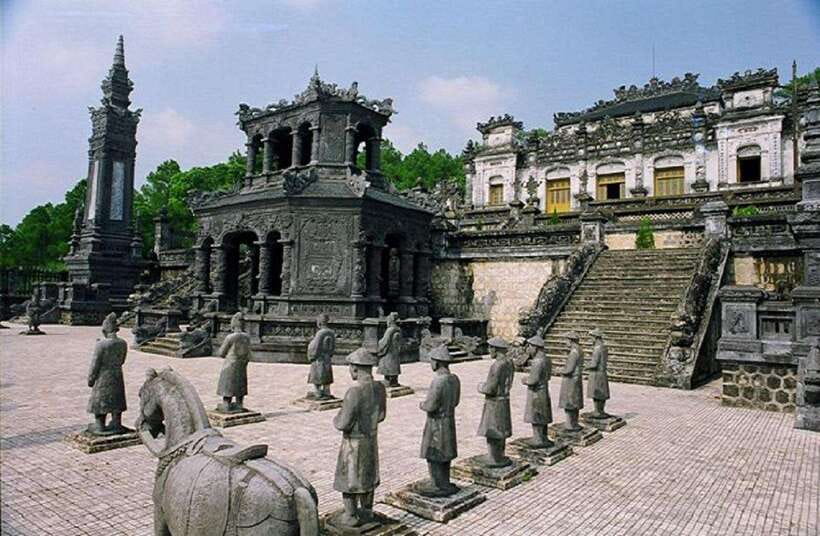
Khai Dinh Tomb is the most visually different of the main royal mausoleums. It was begun in 1920, with Khai Dinh directing the early work until his death in 1925. His child completed it in 1931.
The mausoleum measures about 48.5 meters by 117 meters and is built on a much more compact site than the larger grounds at Tu Duc and Minh Mang. The setting feels tighter and more vertical, with stairs leading through the complex. Be ready for more steps here than at the broad garden-style tombs.
Khai Dinh is the Nguyen royal tomb that most clearly blends Eastern and European styles. Its decoration is busy, detailed, and unlike the calmer planning of Minh Mang. The site is also identified as the only Nguyen royal tomb where the emperor is known to be buried directly beneath the mausoleum.
The suggested stop is 30 minutes, which works for a brisk visit. I would give yourself extra time if you want to study the decoration or take photographs. For many people, this is the most striking tomb, but it is not necessarily the most peaceful one.
A different kind of day out, same stretch of Vietnam:
- From Hue: DMZ Tour with Vinh Moc Tunnels and Khe Sanh Base
★ 4.9 · 503 reviews - Hue: Private Car to Hoi An via Fabulous Stops
★ 5.0 · 371 reviews - From Hue: Hoi An Bus Transfer with 4 Sightseeing Stops
★ 4.6 · 366 reviews - Hue Imperial Ancient City Walking Tour
★ 4.8 · 308 reviews
Gia Long Tomb: space, distance, and a quieter visit
Gia Long Mausoleum honors the founder of the Nguyen Dynasty, Emperor Gia Long, who lived from 1762 to 1820. Construction began in 1814 and finished in 1820. The site is actually a complex of royal mausoleums in Long Ho Ward, within Hue City.
The suggested visit lasts one hour, longer than the stops at Khai Dinh and Dong Khanh. That extra time reflects the scale of the complex and the value of taking the visit at an unhurried pace.
Gia Long is a useful choice if you want more than the standard trio. It helps place the Nguyen dynasty’s royal story at its beginning, before you see the later architectural changes at Tu Duc and Khai Dinh. The tradeoff is simple: adding it makes your day longer, and a short tour cannot give every tomb equal attention.
Ask when booking exactly how this stop will fit your chosen duration. The experience is customizable, but the number of included tombs differs between booking options.
Dong Khanh Tomb: a smaller complex with two distinct zones
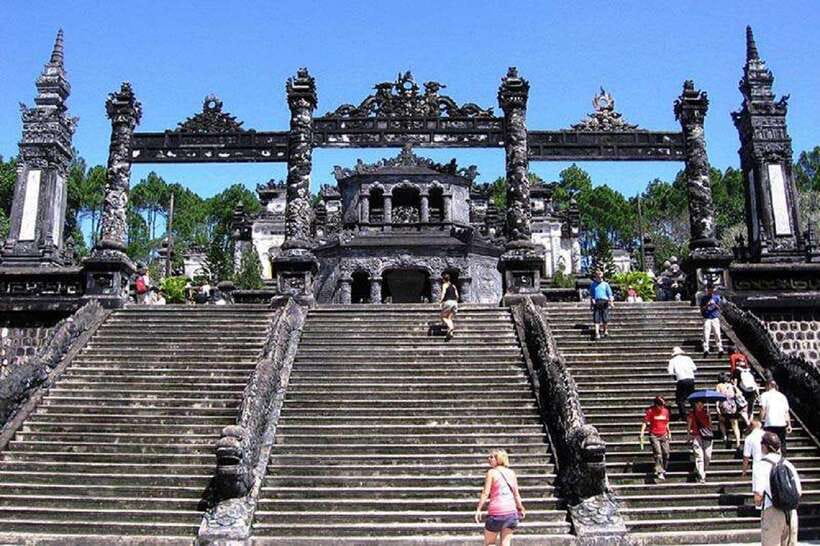
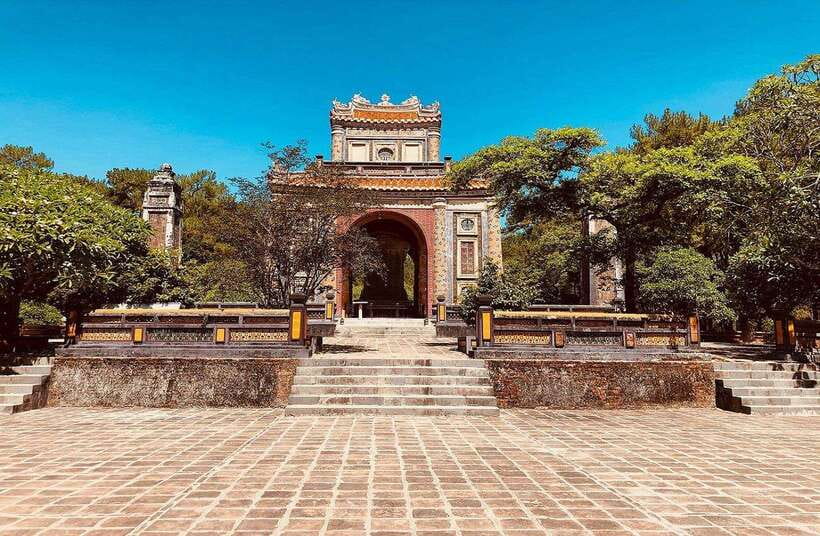
Dong Khanh Tomb, also called Tu Lang, sits in a rural area of Thuong Hai village in Thuy Xuan Ward. It forms part of the Hue ancient capital relic area and contains about 20 large and small structures.
The site is divided into a palace area and a tomb area. Its buildings are set fairly close together, giving it a more compact feel than the broad grounds of Minh Mang or Gia Long.
The suggested visit is 30 minutes. That makes Dong Khanh a sensible addition when you want another royal site but do not want to spend a full hour there. It is also useful for seeing how the layout of a royal mausoleum could vary from one emperor to the next.
Because the stop is less central to the standard first visit, I would add it after you have decided whether Tu Duc, Minh Mang, and Khai Dinh are covered. If your aim is a careful first look at Hue’s most important tombs, the main three should come first.
Thien Mu Pagoda: Hue’s best-known religious landmark
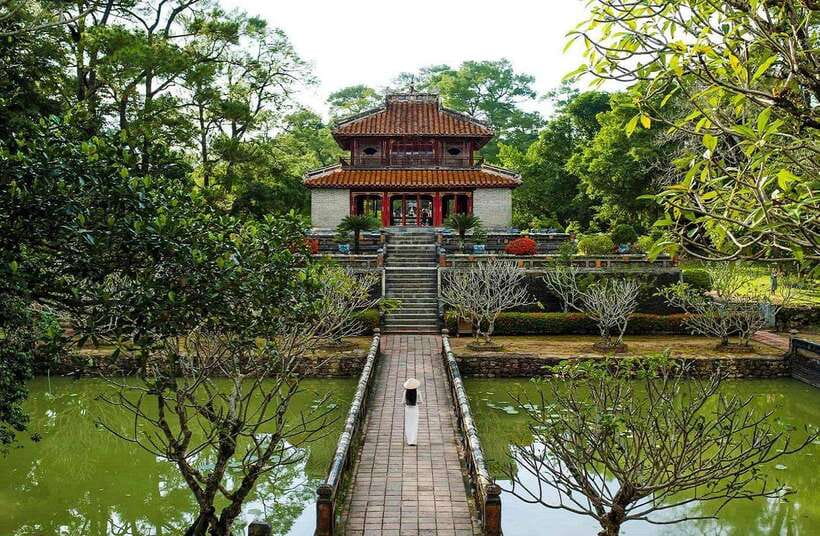
Thien Mu Pagoda was built in 1601 by the founder of the Nguyen family’s rule in central Vietnam. It is one of Hue’s best-known religious sites, associated with a local dream and with the spiritual identity of the city.
The pagoda changes the mood of the tour. After several royal compounds, you turn toward a place that helps explain local Buddhism and daily belief. Your guide can give context about why the site matters to people in Hue, while you take time to look around and enjoy the setting.
The suggested stop is 30 minutes. That is enough for a clear introduction, a walk, and photographs. If religious sites interest you, tell your guide early so the stop does not become a quick photo break.
Thien Mu works well at the end of a tomb-focused route, or as a pause between royal sites. It adds a cultural layer that tombs alone cannot provide.
Tu Hieu Pagoda: a quieter connection to modern Buddhist life
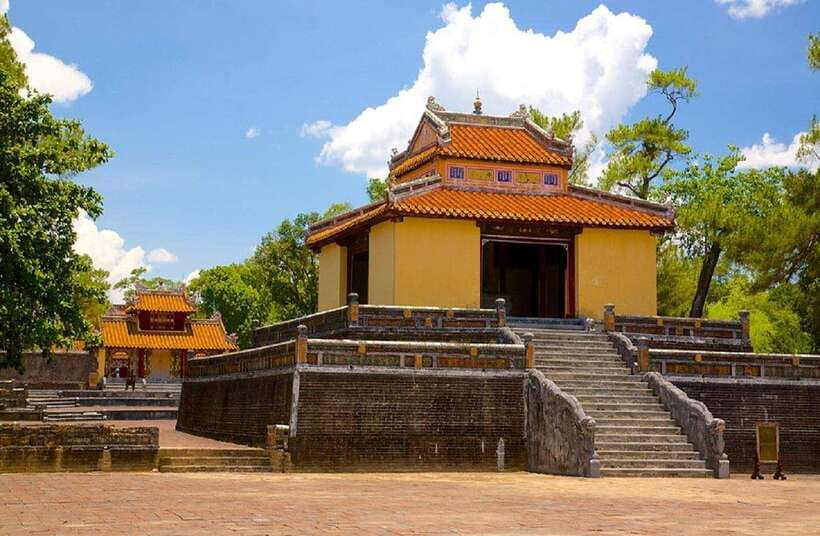
Tu Hieu Pagoda is also known as the Root Temple. It is described as one of Hue’s major temples and a place of cultural and historical importance.
The pagoda is linked with Zen Master Thich Nhat Hanh, the Vietnamese spiritual leader, poet, and peace activist known worldwide for teachings on mindfulness, ethics, and peace. He lived there after returning to Vietnam from the United States.
This stop gives you a bridge between Hue’s older royal past and more recent Buddhist life. It is not just another monument to photograph. It helps you understand how religious places continue to matter beyond the era of emperors.
The suggested visit is 30 minutes, though the quiet setting may encourage you to linger. As with Thien Mu, dress and behave respectfully at the temple, and ask your guide about the appropriate areas to enter.
How the private car changes the day

A private car is the practical reason to book this experience. The tombs are not gathered in one walkable cluster, and trying to arrange separate transport for each one would take time and make the day less flexible.
Pickup is available from hotels in Hue city center or Hue train station, with drop-off back in the city center. You need to provide the exact hotel name and address so the driver can find you easily.
The group is private, and transport is by car or van. That means you can set the pace around your own interests. One person may want to stop for every courtyard and inscription, while another may be ready to move on after the main view. A private schedule handles that better than a large group.
The experience can last from two to eight hours. Be careful with that range. Two hours is enough for a very limited selection, not the complete list of five tombs and two pagodas. For the best-known three tombs, allow a longer half-day. For all seven places, expect to use the upper end of the time range and confirm the exact option before paying.
What the $15 price really covers
At about $15 per person, the tour offers good value mainly because it combines a private vehicle, city-center pickup and drop-off, and the option of an English-speaking guide. The car solves the distance problem, while the guide adds meaning to buildings that can otherwise seem similar.
Entrance fees are separate. The stated cost is 150,000 Vietnamese dong per tomb per person. Food and drinks are also not included.
If you plan to visit Hue’s Imperial City as well, check the combination tickets before buying individual admission. The available examples are 420,000 dong per person for the Imperial City plus two tombs, or 530,000 dong for the Imperial City plus three tombs. These combination tickets are valid for two days.
That can improve the value, but only if your chosen route matches the ticket. Confirm which tombs are included in your selected tour option, since the number of royal tombs differs between options.
Guides and the value of local explanation
The guide is not simply there to point out a gate. The strongest part of the commentary should be the connection between buildings and people: kings, wives, concubines, eunuchs, succession, and the way royal compounds functioned after an emperor died.
English-speaking guides named in past bookings include Bi, Ba, David, Duy, and Tra My. Bi is associated with useful advice about transfers, exchange rates, sightseeing, and local food, including a stop for Hue-style salted coffee. Duy is noted for arriving on time, sharing information about other old sites along the road, and leaving enough time at each tomb.
You should not assume a particular guide will be assigned, but these details show what to value. A good guide helps you understand why Minh Mang feels formal, why Tu Duc feels personal, and why Khai Dinh looks so different. You can also ask for practical local advice, such as where to change money or how to continue to your next destination.
Who should book this Hue tour?
I would recommend it to first-time visitors who want to see the main tombs without arranging transport themselves. It also suits couples, families, and small private groups that prefer control over the pace.
It is a good match if you want a mix of architecture, royal stories, Buddhist sites, and countryside drives. The wheelchair-accessible option is important for anyone who needs that feature, though you should discuss the exact route and site conditions before booking.
I would be more cautious if you want a slow, detailed archaeological visit at every monument. The standard timing is short at several stops, and the full seven-site plan may feel crowded into one day. In that case, choose fewer tombs and use the flexibility to stay longer.
Should you book the Hue Royal Tombs Tour?
Book it if you want an efficient private route through Hue’s royal sites and you value having someone explain the people behind the buildings. Start with Tu Duc, Minh Mang, and Khai Dinh, then add Gia Long or Dong Khanh if you have more time. Thien Mu and Tu Hieu are worthwhile additions when you want Buddhism included.
Before booking, confirm the exact duration, the number of tombs included, the pickup address, and the admission costs. The $15 base price is attractive, but your final spend will rise with entrance fees and any combination ticket.
For most visitors, the best choice is a half-day private tour with three tombs and one pagoda. Choose the full eight-hour version only if you truly want all five mausoleums and both pagodas, and are comfortable with a busy sightseeing day.
FAQ
Where does the tour pick me up?
Pickup is available from hotels in Hue city center or from Hue Train Station. You should provide the exact hotel name and address when booking.
Does the tour return to my hotel?
Yes. The tour includes drop-off back at your hotel in Hue city center.
Is transportation private?
Yes. The experience uses private transportation by car or van, and the group type is private.
Is an English-speaking guide included?
A live English-speaking tour guide is included with the option that specifies a guide. Check your chosen option carefully before booking.
Which royal tombs can I visit?
The available sites include Tu Duc, Minh Mang, Khai Dinh, Gia Long, and Dong Khanh. The exact number included depends on the option you choose.
Are entrance tickets included?
No. Tomb admission is listed separately at 150,000 Vietnamese dong per tomb per person. Combination tickets may be available for the Imperial City and selected tombs.
Are food and drinks included?
No. Food and drinks are not included in the tour price.
Can I cancel or pay later?
You can cancel up to 24 hours in advance for a full refund. The booking system also allows you to reserve now and pay later.
Recently reviewed around Hue Vietnam
- Phong Nha National Park: Paradise Cave Half-Day Tour★ 5.0 · 23 reviews
- Official Hue: Dragon Boat, Imperial Citadel, & Market tour★ 4.7 · 32 reviews
- Hue to Hoi An/Da Nang: Private Scenic Motorbike Tour★ 4.9 · 63 reviews
- Hue: Royal Tombs Private Tour with 3 Best Tombs & Pagoda★ 4.9 · 213 reviews
- Hue: Private Transfer to/from Hoi An via Sightseeing Stops★ 4.9 · 111 reviews
- Hue Private Tour with Local Guide – Customize Your Itinerary★ 4.8 · 28 reviews
- Hue : Private Day Trip to DMZ : Vinh Moc tunnel & Khe Sanh★ 5.0 · 26 reviews
- Hue to Hoi An by bus: Hai Van Pass, Lang Co, Marble mountain★ 4.6 · 27 reviews
Hue Tours, compared.

Hue to Hoi An ( Hoi An to Hue) Top Gear with Lefamily Riders Tours ( 1 way)
Read our review →
Easy Rider private tour via Hai Van pass from Hue – Da Nang – Hoi An (1Way|Loop)
Read our review →
Hue Customizable Tour with Imperial Citadel & Forbidden City
Read our review →
Imperial City, Hue: Day Tour from Hoi An and Da Nang
Read our review →
Easy Rider From Hue Da Nang Hoi An Via Hai Van Pass With Mister T
Read our review →
Hue to Dn/Hoi An: Hai Van Pass, beaches & Mt Monkey or vice versa
Read our review →
Imperial City Walk, Motorbike Tour & Private Car Options
Read our review →
Exploring Royal City with Multi Options and Dragon Boat
Read our review →Browse the lists this tour appears in