
Reviewed · CITY TOURS
Hue: City Sightseeing Hop-On Hop-Off Bus Tour
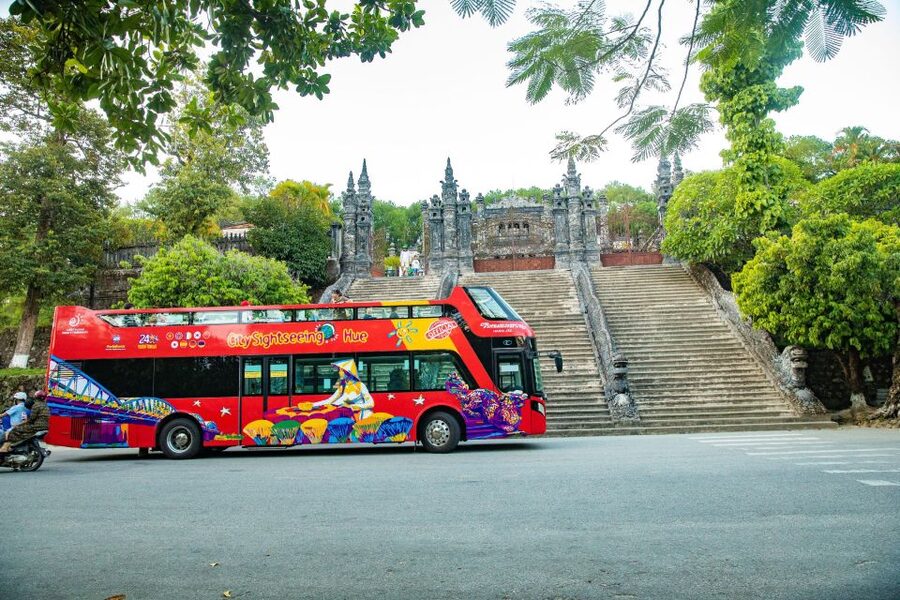
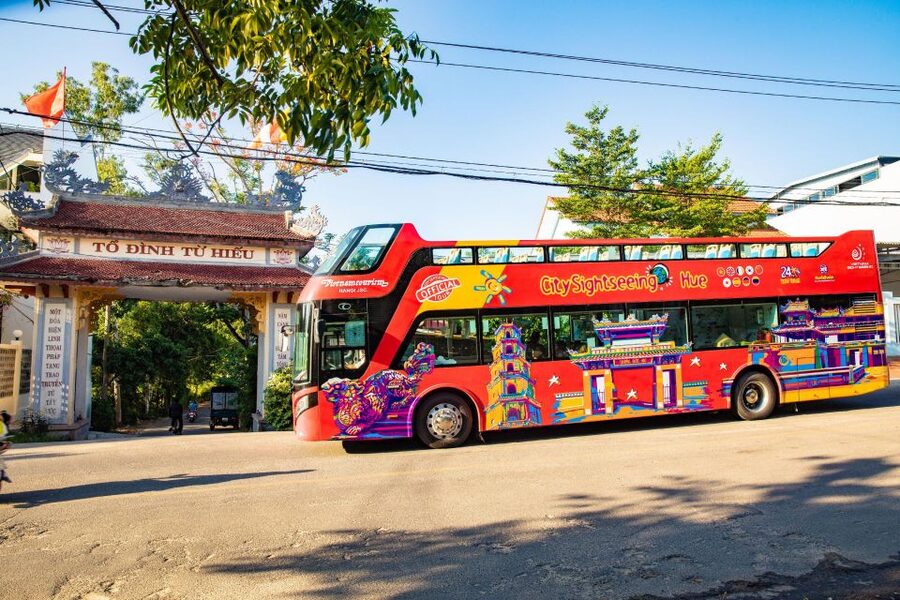
Hue’s hop-on hop-off bus links the city’s main royal sights, from Dong Ba Market and the Imperial Citadel to Tu Duc and Khai Dinh tombs. You can use it as a moving introduction to Hue, then get off where you want more time.
I like the nine-language audio guide and the freedom to build your own day. I also like that mobile and paper vouchers work at any stop. The catch is the 40-minute bus gap, limited operating hours, and some reports of missed buses and faulty commentary.
- Twelve useful stops: Reach the Imperial Citadel, royal tombs, pagodas, gardens, market, train station, and more.
- A strong first-day orientation: The 90-minute full route helps you decide which sights deserve a longer visit.
- Nine audio languages: Choose English, Vietnamese, French, Chinese, Korean, Japanese, Spanish, German, or Russian.
- Market and monument combination: Pair food and shopping at Dong Ba Market with the ceremonial world of the Nguyen emperors.
- Flexible voucher use: Redeem a mobile or printed voucher at any stop, with validity on any day within 12 months of the selected date.
- Plan around the timetable: The first bus leaves Stop 1 at 8am, the last at 4pm, and buses are scheduled every 40 minutes.
In This Review
- A practical way to meet Hue’s royal sights
- Start at Toa Kham Boat Wharf
- Dong Ba Market: Hue’s best stop for local color
- Hue Imperial Citadel: the main event
- An Hien Garden House and Thien Mu Pagoda
- Train Station and Tu Hieu Pagoda
- Pilgrimage Village and Tu Duc Tomb
- Khai Dinh Tomb and the royal outskirts
- Nam Giao Esplanade and Quoc Hoc Hue
- What the audio guide adds, and where it falls short
- Rain, seating, and the bus itself
- Is $19 good value for Hue?
- Booking flexibility and important dates
- Who should book this Hue bus?
- FAQ
- How long does the Hue hop-on hop-off bus tour take?
- What time does the bus operate?
- How many stops are on the route?
- Is entry to the attractions included?
- What languages are available for the audio guide?
- Can I use a mobile voucher?
- Is the bus wheelchair accessible?
- Should you book it?
A practical way to meet Hue’s royal sights
Hue is spread along the Perfume River, with the Imperial Citadel in the city center and several important pagodas, gardens, and royal tombs farther out. This bus gives you a simple way to connect them without arranging separate rides for every stop.
I would use it first as a city orientation rather than as a complete sightseeing solution. The full circuit takes about 90 minutes, but each major attraction needs much longer if you want to look properly. The bus is most useful when you combine a few selected stops with independent visits.
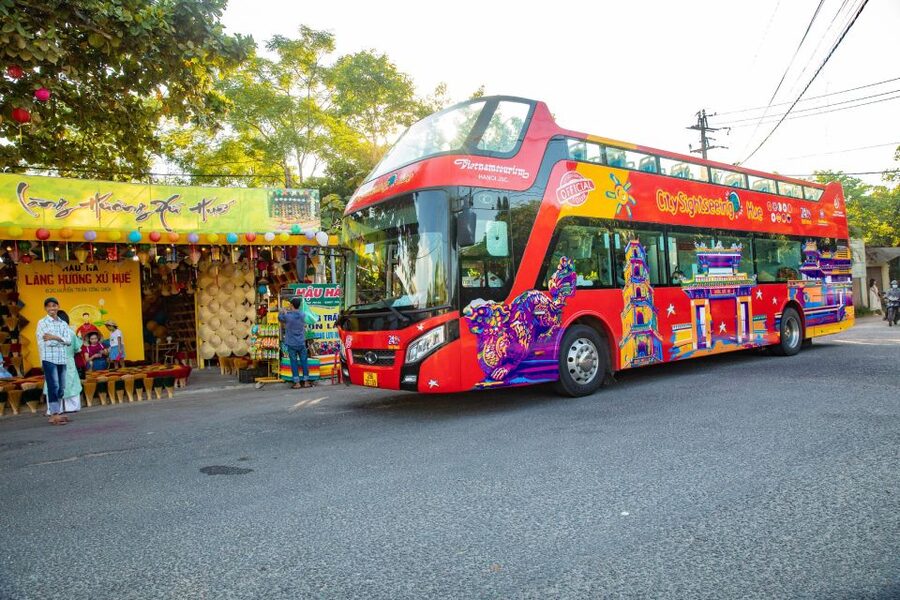
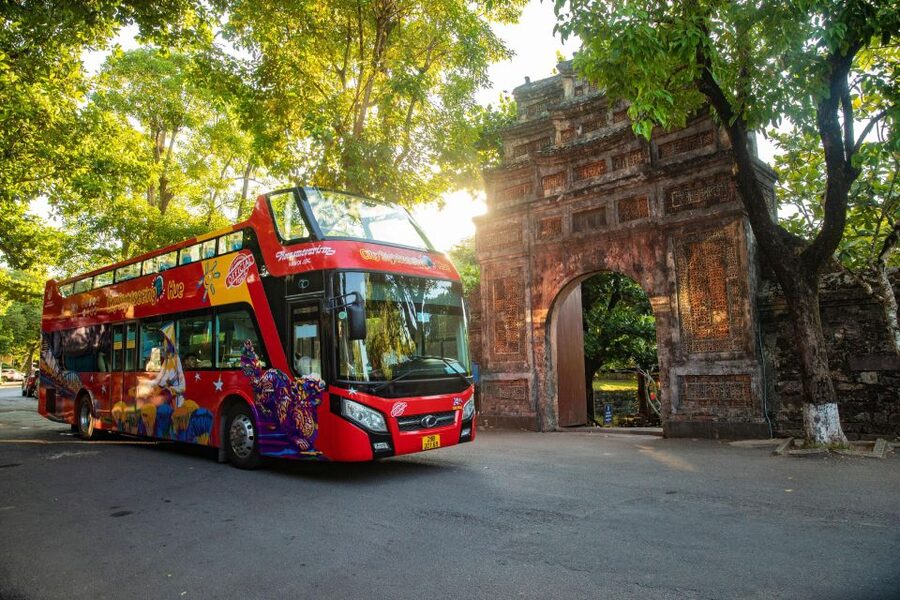
The open-top format should give you a better view on a dry day. Rain changes the experience. You may need to sit downstairs, and that can mean less of the open-air sightseeing feel. The bus itself has been described as clean and comfortable, but the audio system has not always worked consistently.
Start at Toa Kham Boat Wharf
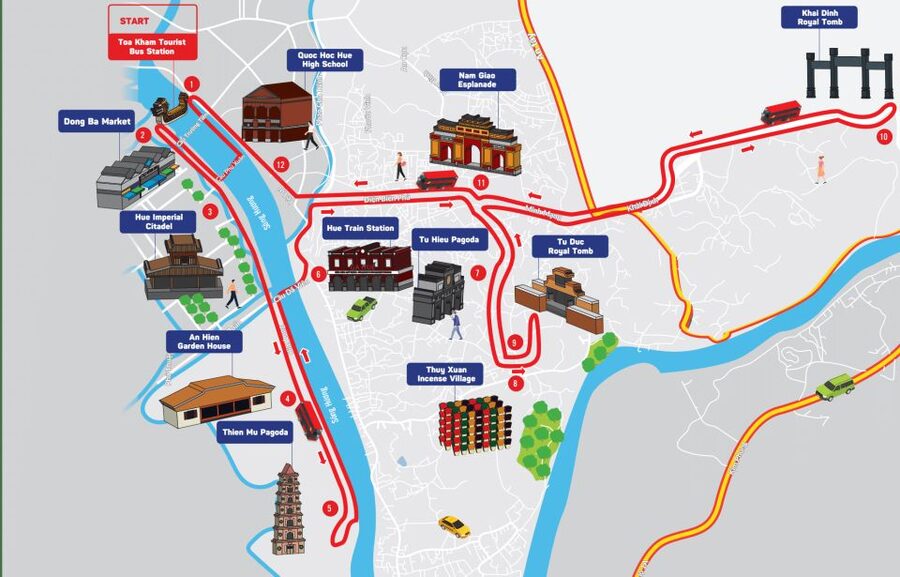
Stop 1 at Toa Kham Boat Wharf is the key departure point. The first scheduled bus leaves here at 8am, and the last leaves at 4pm. Since buses are planned at 40-minute intervals, arriving just after one leaves can cost you a sizeable part of your morning.
I would begin here if you want the whole route before choosing where to get off. It is also the place to keep in mind when planning your return. A 4pm final departure gives you useful daytime transport, but not a late-night sightseeing service.
Your voucher can be redeemed at any stop, so you do not have to begin at Stop 1. Still, starting here makes the schedule easier to understand. Keep your passport or ID card with you, along with either the mobile voucher or its printed version.
More City Tours in Hue
- Hue Customizable Tour with Imperial Citadel & Forbidden City
★ 4.9 · 937 reviews - Hue :Exploring Royal City with Multi Options and Dragon Boat
★ 5.0 · 675 reviews - Hue City Tour Full Day – Group Tour
★ 4.7 · 518 reviews
Dong Ba Market: Hue’s best stop for local color
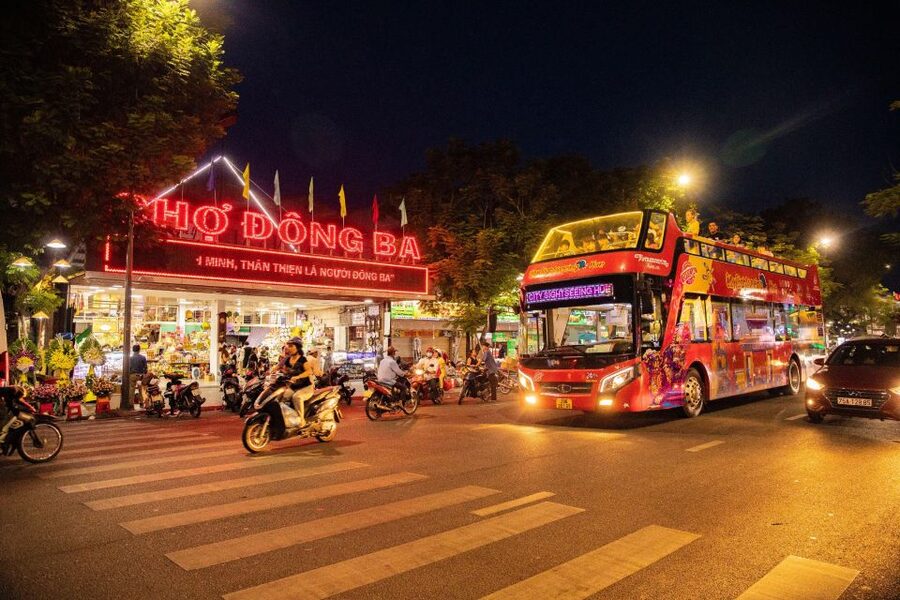
Dong Ba Market is a good early stop if you want food, household goods, spices, fresh produce, handicrafts, and souvenirs in one place. You can wander through the rows of stalls, but keep your sense of direction. The market is designed for browsing, not for a quick five-minute visit.
This is also the place to try banh khoai, a sweet and crispy pancake highlighted as a local must. Food and drinks are not included in the bus ticket, so plan to pay separately. The market gives the itinerary a welcome change of pace after the formal palace sites.
I would allow extra time here if shopping or eating is part of your plan. If you are using the bus mainly for monuments, this stop may be less important than the Imperial Citadel. If you want a stronger feel for everyday Hue, it is one of the most useful places to get off.
Hue Imperial Citadel: the main event
Stop 3 serves the Hue Imperial Citadel, the city’s major royal complex and a UNESCO World Heritage Site. Think of it as a walled city within Hue, with gates, temples, palaces, and ceremonial spaces linked to the Nguyen emperors.
The audio commentary can give you useful context before you enter. Still, do not confuse the bus commentary with a guided visit. Entry to the Citadel is not included, and you will need time on foot to see the complex properly.
I would make this the priority stop on a one-day ticket. The Citadel is too important to treat as a quick photo break. Get off, allow a generous visit, and use a later bus only if the timing works. The changing of the guard ceremony is specifically noted as worth staying for, though the supplied schedule does not give a ceremony time. Ask at the stop or entrance so you do not build your whole day around a guess.
An Hien Garden House and Thien Mu Pagoda

An Hien Garden House offers a different view of Hue from the grand imperial buildings. Its inclusion gives you a chance to see one of the city’s traditional residential garden settings rather than only official monuments.
Next comes Thien Mu Pagoda, one of Hue’s best-known religious landmarks. The stop lets you pair royal architecture with a major Buddhist site. If you are interested in architecture, religion, or the quieter side of the city, these two stops are worth considering.
The practical issue is time. With a bus every 40 minutes, you need to watch the clock. If you get off at both stops, you may spend much of the day waiting between visits. I would choose one on a tight one-day schedule, then save the other for a second day or a separate taxi ride.
More Hue Vietnam trips worth a second look
- Hue Imperial Ancient City Walking Tour
★ 4.8 · 308 reviews - From Da Nang/Hoian/Hue: Hue Imperial City Full-Day Tour
★ 4.8 · 295 reviews - Hue City Tour Full day – Small group tour
★ 4.7 · 137 reviews - Hue City: Cyclo, Market Tour & Cooking Class at Madam Thu
★ 5.0 · 48 reviews
Train Station and Tu Hieu Pagoda

Hue Train Station is Stop 6. This is mainly useful if your arrival or departure connects with the railway, or if you want a transport landmark included in your city route. It is not presented as one of the headline sightseeing stops, so you may have little reason to leave the bus here unless your plans call for it.
Tu Hieu Pagoda gives the route another religious and cultural stop. Like Thien Mu Pagoda, it can appeal to you if you want more than imperial buildings and tombs. The two pagoda stops also remind you that Hue’s identity is not only about palaces and emperors.
The bus works best when you pick sights that match your interests. You do not need to leave at every stop simply because the ticket allows it. A hop-on hop-off ticket gives you control, but it does not remove the need to make choices.
Pilgrimage Village and Tu Duc Tomb

Pilgrimage Village is Stop 8 and adds a resort-style stop to the route. The information supplied does not specify which facilities or activities are included there, so treat it as a possible pause rather than a guaranteed highlight. There is no indication that food, drinks, or any resort services are part of the ticket.
Tu Duc Tomb is a stronger choice for history-minded visitors. Emperor Tu Duc and his empress are connected with the site, and the commentary covers his luxurious, extravagant life. The tomb gives you a more personal view of imperial power than the Citadel, where the focus is on gates, palaces, and official ceremony.
Do not expect to see the tomb properly during a short hop-off. The 40-minute service interval may be enough for a brisk visit, but you should check the next departure before walking away from the stop. If the bus is late or a departure is missed, your carefully planned sequence can unravel.
Khai Dinh Tomb and the royal outskirts
Khai Dinh Tomb is Stop 10 and another major royal site outside the central city. Its presence makes the bus more useful than a simple downtown loop, especially if you want to compare different imperial tombs.
Tu Duc’s tomb is tied to an emperor’s extravagant life. Khai Dinh gives you another royal setting and helps show that Hue’s monuments are spread across a wider area. Visiting both is possible with a two-day ticket, but it may be rushed on one day if you also want the Citadel, market, and a pagoda.
Entry fees are not included. Add those costs before deciding that the $19 ticket is your cheapest transport option. The value improves when you visit several included route stops, especially places that would otherwise require separate rides. It is weaker if you only need transport to one attraction.
Nam Giao Esplanade and Quoc Hoc Hue
Nam Giao Esplanade is Stop 11. Its presence points to Hue’s ceremonial past and gives the route another imperial-era site beyond the palace and tombs. Quoc Hoc Hue, Stop 12, completes the listed circuit with an educational and civic landmark.
These final stops may appeal to you if you want a broader picture of Hue instead of only the famous headline sights. For a first visit, I would place them behind the Imperial Citadel, Dong Ba Market, and at least one royal tomb.
The bus route is most valuable when you use these lesser-prioritized stops as optional additions. That is the benefit of the format: you can change your plan. The drawback is that the schedule does not give unlimited time, especially on a one-day ticket.
What the audio guide adds, and where it falls short

The audio guide is available in English, Vietnamese, French, Chinese, Korean, Japanese, Spanish, German, and Russian. That is a real advantage if you want basic background without hiring a private guide or joining a fixed walking group.
I would listen during the moving portions and then use the information to decide where to spend your time. The commentary is best understood as an introduction. It cannot replace the freedom to explore the Citadel, market, or tombs at your own pace.
Audio reliability is an important consideration. On one rainy outing, the commentary cut out several times, and changing seats helped only partly. The attendant worked to restore it, but some information was still missed. If the narration matters greatly to you, keep your expectations measured and pay attention to the landmarks outside the windows too.
Rain, seating, and the bus itself
The bus has an upper deck and a downstairs area. On a dry day, the upper deck should give you the clearest sightseeing experience. On a rainy day, you may be confined downstairs, where the views and atmosphere are less appealing.
The vehicle has been described as clean and comfortable, and the driver and attendant have been friendly and helpful. That is encouraging, but it does not erase the need to plan around the timetable. Some departures have reportedly failed to arrive, and there have been complaints about buses not running as expected.
For that reason, I would not use this as your only transport on a day when you must catch a train or flight. Leave a buffer. If a bus does not appear, ask staff at the stop promptly rather than waiting through several scheduled intervals.
The service is wheelchair accessible. Pets and smoking are not allowed.
Is $19 good value for Hue?
At $19 per person, the ticket can be fair value if you use it for orientation and several distant sights. You get the bus for one or two days, audio in nine languages, WiFi, and stops near the main attractions. You also avoid arranging separate transport for every move.
The price does not include entry to the Imperial Citadel, tombs, pagodas, or other attractions. Food and drinks are also extra. Once you add admission fees, the total cost is higher than the headline bus price, so compare it with the cost of local transport for the exact places you want to visit.
I see the best value in a two-day plan. Use the first day for the full circuit, Dong Ba Market, and the Imperial Citadel. Use the second day for Tu Duc Tomb, Khai Dinh Tomb, a pagoda, and any stop you skipped. A one-day ticket can work, but only if you accept a brisk schedule.
The ticket is also useful for decision-making. You can ride around Hue, hear the basic commentary, and then return to the sites that appeal to you most. That makes the bus less about checking off every stop and more about finding your own priorities.
Booking flexibility and important dates
You can cancel up to 24 hours before the activity for a full refund, and the reserve-now, pay-later option keeps your plans open. A mobile or printed voucher is accepted, and the voucher can be redeemed at any stop. It can be used on any day within 12 months of the travel date selected at checkout.
Check the actual operating date before you book. The tour does not run on February 16 because of Lunar New Year. On February 17, service runs from 10:15am until 9pm rather than following the normal timetable.
The meeting point can vary by the option booked. Check your confirmation carefully, even though Stop 1 at Toa Kham Boat Wharf is the main departure point described for the route.
Who should book this Hue bus?
I would recommend it to you if you are visiting Hue for the first time, want a broad introduction, or prefer not to arrange several separate rides. It is also a sensible choice if you value multilingual commentary and want access to both central sights and outlying royal tombs.
It suits independent planners who are happy to watch the clock. You can hop off whenever you like, but buses are scheduled every 40 minutes, and a missed connection can take a large bite out of your day.
I would be cautious if you have only a few hours, need guaranteed transport, or want a fully guided visit inside each monument. The service has had enough timetable and audio problems that I would keep a backup plan, especially in bad weather.
FAQ
How long does the Hue hop-on hop-off bus tour take?
The full tour duration is about 90 minutes without getting off. Your ticket is valid for either one day or two days, depending on the option you book.
What time does the bus operate?
The first tour departs from Stop 1 at 8am, and the last tour departs from Stop 1 at 4pm. Buses are scheduled every 40 minutes.
How many stops are on the route?
There are 12 listed stops, including Toa Kham Boat Wharf, Dong Ba Market, Hue Imperial Citadel, Thien Mu Pagoda, Tu Duc Tomb, Khai Dinh Tomb, Nam Giao Esplanade, and Quoc Hoc Hue.
Is entry to the attractions included?
No. The ticket includes the hop-on hop-off bus, stops near major sights, the audio guide, and WiFi. Attraction entry, food, and drinks are not included.
What languages are available for the audio guide?
The audio guide is available in English, Vietnamese, French, Chinese, Korean, Japanese, Spanish, German, and Russian.
Can I use a mobile voucher?
Yes. Both mobile and printed paper vouchers are accepted. You can redeem the voucher at any stop along the route.
Is the bus wheelchair accessible?
Yes, the activity is listed as wheelchair accessible. Pets are not allowed, and smoking is prohibited.
Should you book it?
Book this tour if you want a flexible first look at Hue and plan to visit several places along the route. The Imperial Citadel, Dong Ba Market, and the royal tombs give the ticket its strongest value, while the multilingual audio and WiFi make the ride more useful than simple point-to-point transport.
I would choose two days if your schedule allows. For one day, focus on the Citadel, market, and one tomb, and treat the rest as optional. Keep extra time in hand because the 40-minute intervals, rainy weather, audio faults, and occasional service problems can affect your plans. Used with that caution, the bus is a handy Hue introduction, not a substitute for time spent inside the city’s best sights.
Recently reviewed around Hue Vietnam
- Phong Nha National Park: Paradise Cave Half-Day Tour★ 5.0 · 23 reviews
- Official Hue: Dragon Boat, Imperial Citadel, & Market tour★ 4.7 · 32 reviews
- Hue to Hoi An/Da Nang: Private Scenic Motorbike Tour★ 4.9 · 63 reviews
- Hue: Royal Tombs Private Tour with 3 Best Tombs & Pagoda★ 4.9 · 213 reviews
- Hue: Private Transfer to/from Hoi An via Sightseeing Stops★ 4.9 · 111 reviews
- Hue Royal Tombs Tour: Visit Best Pagodas & Mausoleums★ 4.9 · 19 reviews
- Hue Private Tour with Local Guide – Customize Your Itinerary★ 4.8 · 28 reviews
- Hue : Private Day Trip to DMZ : Vinh Moc tunnel & Khe Sanh★ 5.0 · 26 reviews
City Tours, compared.

Cu Chi Tunnels Tour from HCM City – Morning or Afternoon
Read our review →

Ho Chi Minh City Street Food Tour & Sightseeing By Motorbike
Read our review →
Mekong Delta Guided Tour from Ho Chi Minh City
Read our review →
Private Street Food Evening Walking Tour in Ho Chi Minh City
Read our review →
Top Notch Street Food Motorbike Tour In Ho Chi Minh City
Read our review →
Private Street Food Motorbike Tour in Ho Chi Minh City
Read our review →
Cu Chi Tunnels Experience from Ho Chi Minh City
Read our review →Browse the lists this tour appears in