
Reviewed · WORKSHOPS
Hanoi Knife Making Traditional Workshop
The most unusual souvenir in Hanoi may be one you hammer into shape yourself. At this three-hour workshop in Da Sy village, you work beside a Vietnamese knife maker, from rough metal to a finished blade, then carry the result home.
I like two things here: you get a real look at a working craft village, and the $50 price includes hotel pickup, instruction, tools, water, and the knife itself. Guides such as Tee, Nathan, Khoi, and Minh also help bridge the language gap. The main consideration is that this is a beginner-friendly workshop, not a full blacksmithing course. You will do plenty, but a skilled maker handles the most dangerous machine work.
In This Review
- What makes this Hanoi workshop worth your morning
- Reaching Da Sy village from Hanoi
- A village shaped by the forge
- Choosing the blade before the fire
- Cutting and heating the steel
- Hammering the blade beside the maker
- Grinding, tempering, and sharpening
- Making the handle and personal fit
- What the $50 price really covers
- Timing, group size, and comfort
- Who will enjoy this most
- A practical souvenir with a story
- Should you book the Da Sy knife-making class?
- FAQ
- Where does the knife-making workshop take place?
- How long does the activity last?
- What is included in the $50 price?
- Is hotel pickup included?
- Is the class taught in English?
- Do I need blacksmithing experience?
- Can I choose the knife design?
- Will I make every part of the knife myself?
- What should I bring?
- Can I cancel for a full refund?
- Are there holiday surcharges?
What makes this Hanoi workshop worth your morning
- You shape a knife from raw metal: The process includes design, cutting, forging, grinding, sharpening, and handle work.
- You work in Da Sy’s forging village: The village has practiced metalwork for several hundred years and once supplied weapons during wartime.
- You choose your knife design: You can select from examples or use a photo as a starting point.
- You get genuine local contact: The family-run workshop welcomes you with guidance, tea, snacks, fruit, or candy when available.
- You receive a useful souvenir: The finished knife is not just a display piece. Several participants chose kitchen knives for use at home.
- Hotel pickup keeps things simple: Transport, an English-speaking guide, equipment, water, and the finished product are included.
Reaching Da Sy village from Hanoi
The workshop takes place outside central Hanoi in Da Sy village, in the Dong Bac area listed for the activity. Pickup is included from your hotel, and you are asked to wait five minutes in the lobby. A driver takes you to the village while your English-speaking guide explains the visit and helps with translation.
This transfer matters. You do not need to work out a separate taxi, find a rural workshop, or worry about arriving at a house where nobody speaks English. Guides have also used the drive to explain Vietnamese history and daily life. Nathan, for example, was praised for talking about Vietnam on the way and pointing out local fruits, tea, and sweets.
The group can be small, and some sessions have effectively been private or limited to two people. A group of six has also completed the class together, so the exact feel depends on the date you choose. If personal instruction matters to you, check availability for a small-group session.
Da Sy is not presented as a polished museum village. You are visiting a working family business where forging remains part of everyday trade. That gives the class its appeal, but it also means you should expect heat, noise, metal dust, and practical workshop conditions rather than a quiet studio.
More Hanoi trips worth a second look
- Hanoi Cooking Class: Culture, Local Market & Meaning CSR Impact
★ 5.0 · 5,147 reviews - 5 Traditional Dishes Hanoi Cooking Class with Market Trip
★ 5.0 · 4,890 reviews - Hanoi Coffee Workshop: Taste Salt, Coconut and Egg Coffee
★ 5.0 · 1,286 reviews
A village shaped by the forge
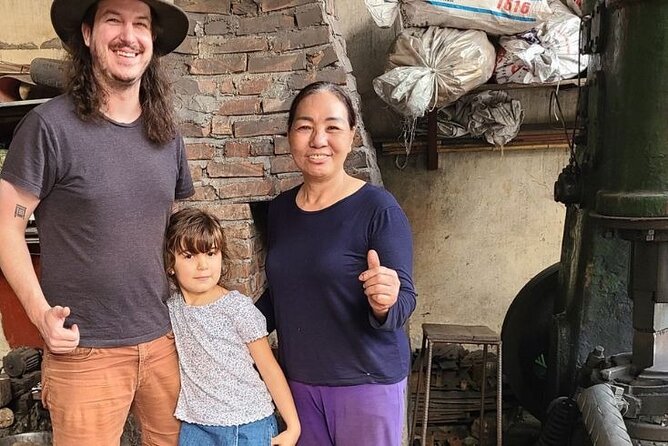
Da Sy’s forging tradition reaches back several hundred years. Its earlier role included making weapons during the Vietnam wars. Today, the village is better known for agricultural tools and household blades, but the old skills continue in the same basic setting: fire, hammer, anvil, grinding wheel, and careful handwork.
That background gives the class more meaning than a simple souvenir-making session. You see why forged tools still matter in a rural economy and how a family trade passes from one generation to the next. The craft is not staged as a performance for a visiting audience. The local makers are doing work they know well, and you take part under their supervision.
The family-run nature of the workshop is one of its strongest features. The maker may not speak English, so your guide translates instructions and conversation. Guides including Tee and Khoi have been especially helpful in explaining what the artisan is doing and making sure you understand the next step.
The social side is worth allowing time for. Once the metalwork is finished, you may be offered tea or a small snack and shown around the shop. This informal visit helps you see the people behind the product, rather than simply buying a blade from a shop counter.
Choosing the blade before the fire
The class begins with a choice of knife design. You can select from several styles, or show a photo and discuss a variation. One participant combined features of an artisan’s model with a Japanese kiritsuke shape. Others chose kitchen knives.
This is a useful feature because your knife can reflect how you plan to use it. A practical kitchen blade makes sense if you want a souvenir that earns its place in a drawer. A more distinctive shape may appeal if the knife is destined for a collection.
You then sketch the outline on a sheet of durable metal. This step looks simple, but the drawing controls the final proportions of the blade and tang. The tang is the metal section that extends into the handle. It needs to be shaped correctly so the handle fits securely.
Do not expect a long design consultation or engineering lesson. The class is aimed at first-timers, so the maker helps keep the design workable. That is a good safeguard. A complicated shape may look attractive in a photograph but can be difficult to forge and sharpen within a short session.
Cutting and heating the steel
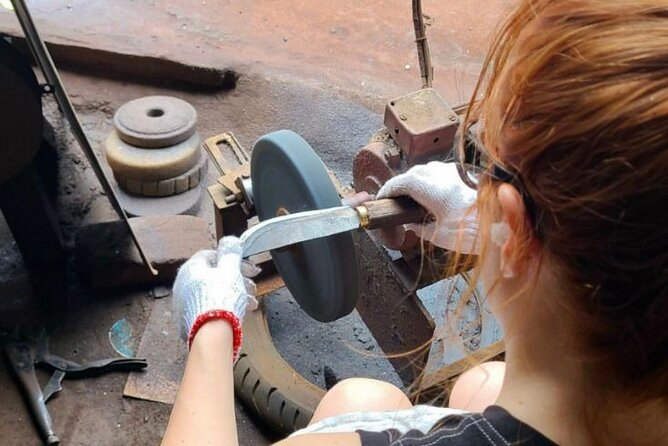
After the design is marked, the blade and tang are cut from the metal. The basic tools include a hammer, cutter, and anvil. The metal then goes into glowing embers, where it becomes workable.
This is the moment when the class begins to feel like blacksmithing rather than craft decoration. You see the color of hot steel change and learn why timing matters. The maker controls the fire and shows you how to place and handle the piece.
Safety limits are important here. You can take part in the forging, but the family does not simply hand you a hot piece of steel and step away. You work under close supervision, and the guide translates instructions as needed. Wear the gloves provided and listen carefully. A sharp blade, hot metal, and heavy tools are not forgiving of careless movements.
Comfortable shoes are the only specific item requested, but closed, sturdy footwear is the sensible choice. Avoid loose clothing if possible, and do not bring alcohol or drugs. The work area is active, so keep your attention on the demonstration rather than trying to take photographs during a dangerous step.
A different kind of day out, same stretch of Vietnam:
- Hanoi Jeep Tour: Food, Culture and Fun by Vietnam Army Jeep
★ 5.0 · 15,222 reviews - Full-Day Ninh Binh Highlights Tour from Hanoi
★ 5.0 · 7,761 reviews - Hanoi: Ha Long Bay Day Cruise – Swimming, Meal, Kayaking
★ 4.7 · 7,415 reviews - Hanoi: Water Puppet Show Tickets
★ 4.6 · 7,029 reviews
Hammering the blade beside the maker
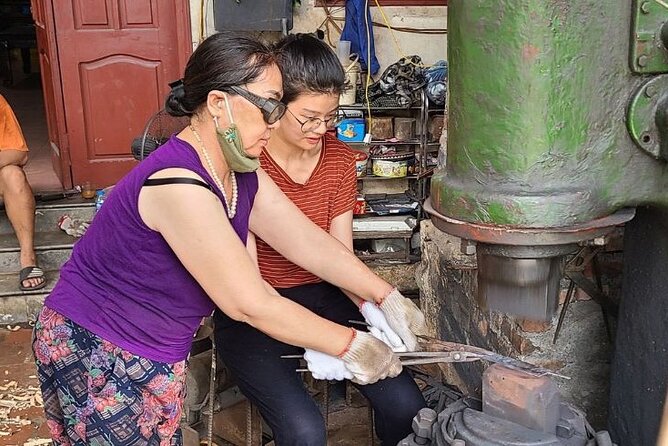
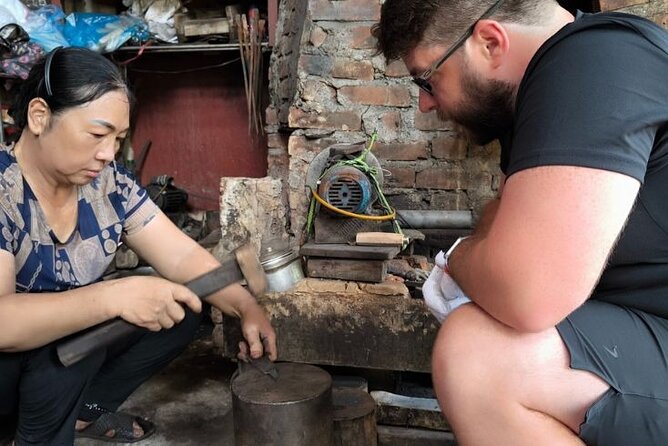
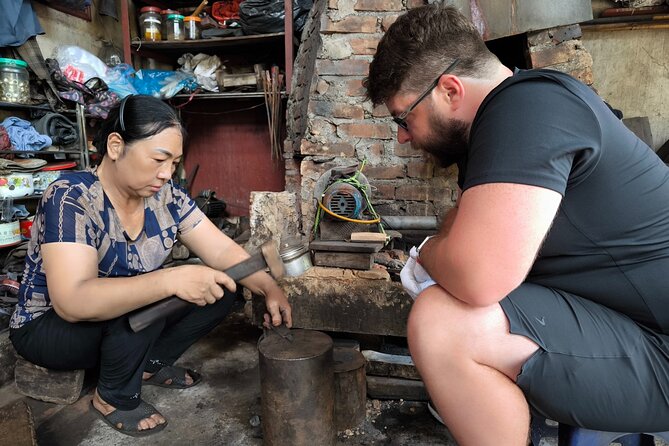
Once the steel is hot, you help shape it on the anvil. You alternate hammer blows with the maker, gradually drawing out the blade and forming the tang.
This is the most satisfying part of the class because you can see your knife take shape. It is also the part where expectations need managing. Some people get a great deal of hands-on time, including hammering, polishing, sharpening, and handle work. Others find that the artisan completes much of the skilled work while they take part in selected steps.
Both approaches are understandable. A master maker can produce a safe, balanced knife much faster than a beginner. The workshop also has a duty to protect your hands and fingers. One useful option offered during some sessions is a choice between doing nearly everything yourself under supervision or letting the master handle most of the work.
If you want the fullest possible participation, say so at the start. Ask which steps you can handle and which require the artisan. That small conversation can shape the entire class. You should not expect to operate the most dangerous equipment, but you can often do more than simply watch.
The hydraulic cutting machine is used to trim imperfections and refine the shape. This is one of the steps that may be handled by the staff. It is fast and powerful, and it is not suitable for casual use by a beginner.
Grinding, tempering, and sharpening
After forging, the blade is taken to a grindstone. The maker removes rough edges and begins forming the cutting bevel. This is another stage where a trained hand makes a major difference. Too much pressure or the wrong angle can spoil the blade.
The heat treatment includes soaking the metal in a tar-based chemical wash made from a secret family recipe. The exact formula is not explained, but the step is part of the workshop’s traditional method. You see that knife making is not simply hammering steel until it looks like a blade. Heat, cooling, grinding, and sharpening all affect the final result.
The last sharpening can produce a remarkably keen edge. Several participants described their finished knives as razor sharp, so handle the blade carefully once it is handed over. Ask the guide or maker how to carry and store it safely, particularly if you are packing it for a flight.
This part of the process also helps you appreciate the maker’s skill. The rough metal you first sketch bears little resemblance to the finished knife. By the end, the blade has a clean shape, polished surfaces, and a working edge.
Making the handle and personal fit
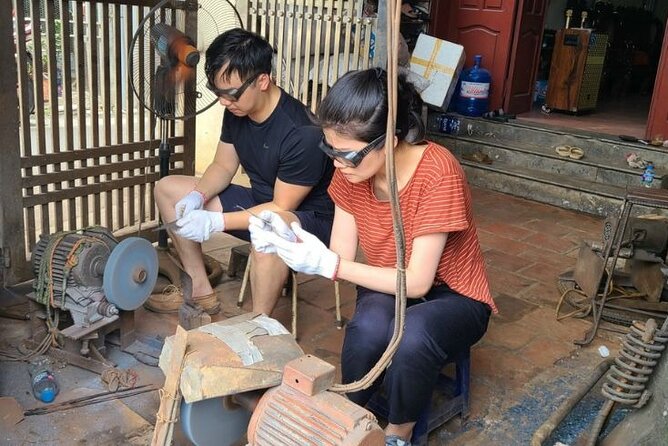
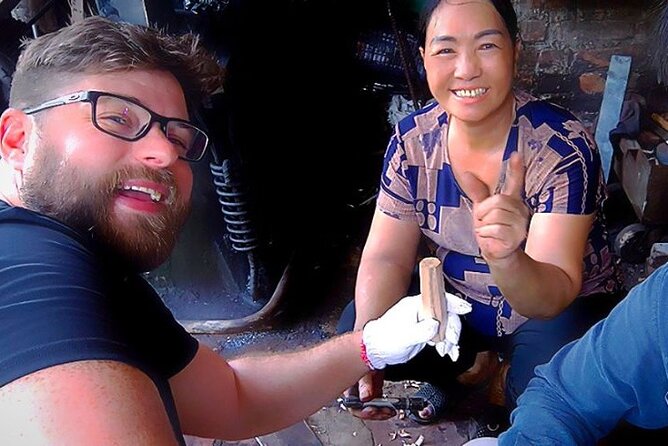
Handle work adds a more personal touch. Depending on the design, you may carve or shape the wooden handle yourself, then work with the maker to fit it to the tang.
One participant particularly liked being able to make a handle that fit the hand. That option matters because a knife is not only about appearance. The handle affects comfort, control, and the way the finished piece feels when you hold it.
As with the blade, the level of participation can vary. You may carry out much of the shaping with help, or the artisan may finish the most precise work. The guide translates instructions and helps you understand the correct grip and position.
The completed knife can look surprisingly professional, especially considering that you began with a flat piece of metal. It is also more memorable than a mass-produced souvenir because you took part in its making and saw the family workshop where it was produced.
What the $50 price really covers
At $50 per person, the value is strong if you want more than a short demonstration. The fee includes:
- Hotel pickup and return transport
- English-speaking instruction and guide support
- The local master knife maker
- Workshop equipment
- One 500-milliliter bottle of water
- The finished knife or other product you make
Transport alone adds useful value, especially since the village lies outside central Hanoi. You also avoid paying separately for a craft demonstration, a rural visit, and a souvenir.
The price makes the most sense for someone who values participation and local contact. If you only want to buy an inexpensive kitchen knife, a market will be quicker and cheaper. If you want to understand how the knife is forged and take part in the process, this workshop offers much more.
There is a $10 surcharge during New Year and Tet, Liberation Day or Reunification Day on April 30, International Workers’ Day on May 1, and National Day on September 2. Keep that in mind when comparing dates.
Timing, group size, and comfort
The advertised duration is three hours, with starting times based on availability. Individual sessions can run shorter. One participant described spending about two hours at the workshop, while other accounts describe a full morning. The amount of hands-on work, group size, and the pace of the maker can affect the length.
A small group is the best fit for this activity. You have more room to ask questions, receive help with the hammer, and work on the handle without waiting. Larger groups can still enjoy the class, but the personal time at each stage may be reduced.
You should wear comfortable shoes and clothing suitable for a hot, active work area. The workshop includes fire and metalworking, so this is not the right pick if you dislike heat, noise, dust, or close supervision around tools.
Free cancellation is available up to 24 hours before the activity for a full refund. You can also reserve now and pay later, which helps if you are still adjusting your Hanoi schedule. The activity is listed as unsuitable for people over 95 years old.
Who will enjoy this most
I would recommend this for first-time makers, couples, families with older children, and anyone who prefers a useful souvenir to another decorative trinket. You do not need previous blacksmithing experience. Patience and a willingness to follow instructions matter more than technical skill.
Teens have enjoyed the activity, and adults who love knives, cooking, woodworking, or handmade tools will find plenty to study. It is also a good choice for someone who has already seen Hanoi’s temples and food markets and wants a closer look at work outside the city center.
I would be more cautious about recommending it to an experienced blacksmith or serious do-it-yourself maker. The class is designed for beginners, and the artisan may complete much of the precision work. You will participate, but you will not leave with professional blacksmithing skills.
The class also suits solo visitors. A guide can help with translation, take photographs and videos, and make the session feel personal. Tee, Nathan, Khoi, and Minh have each been praised for clear English, friendly conversation, and steady help during the workshop.
A practical souvenir with a story
The finished knife is the main reward, but the memory comes from knowing how it was made. You remember the sketch, the first hammer blows, the heat of the forge, the grinding wheel, and the final sharpening.
Some people have made two kitchen knives, while others have selected a single custom shape. You can also purchase additional knives at reasonable prices, although any extra purchase is separate from the included product.
Plan how you will transport the blade home. It is sharp, and international airline rules may apply. Pack it safely and check your airline’s requirements before departure. The workshop provides the product, but the responsibility for carrying it legally and securely rests with you.
The class also gives you a small connection to Da Sy’s working life. You meet the family, see the tools, share a drink or snack, and leave with something made in front of you. That is a more lasting souvenir than a quick stop at a shop.
Should you book the Da Sy knife-making class?
Book it if you want a hands-on morning, enjoy meeting local makers, and like the idea of taking home a knife with your own input. The hotel pickup, English guide, small-group option, equipment, and finished product make $50 a fair price.
Go in with the right expectation. You are not training to become a blacksmith in three hours. You are learning the main stages, taking part where it is safe, and relying on an experienced maker for the precise and risky work.
For most first-timers, that balance is exactly right. Ask at the beginning how much of the process you can do yourself, wear sturdy shoes, use the gloves, and treat the finished blade with care. If those conditions suit you, this is one of Hanoi’s more distinctive craft experiences.
FAQ
Where does the knife-making workshop take place?
The activity takes place in Da Sy village in the Dong Bac area of Vietnam, on the outskirts of Hanoi.
How long does the activity last?
The advertised duration is three hours. Starting times depend on availability, and some sessions may take about two hours.
What is included in the $50 price?
The price includes English-speaking instruction, an English-speaking guide, the local master, equipment, one 500-milliliter bottle of water, hotel pickup, and the product you make.
Is hotel pickup included?
Yes. Pickup from your hotel is included. You should wait five minutes in the hotel lobby.
Is the class taught in English?
The tour guide provides live English support and translates between you and the local knife maker.
Do I need blacksmithing experience?
No. The activity is designed for beginners, and the makers guide you through each stage.
Can I choose the knife design?
Yes. You can choose from available designs or use a photograph as inspiration for the knife you want to make.
Will I make every part of the knife myself?
You can take part in many stages under supervision, but the artisan may handle dangerous equipment and some precision work. You can discuss how much you want to do at the start.
What should I bring?
Bring comfortable shoes. Gloves should be used during the workshop, especially during the hot-metal and hammering stages.
Can I cancel for a full refund?
Yes. You can cancel up to 24 hours in advance for a full refund. You can also reserve now and pay later.
Are there holiday surcharges?
Yes. There is a $10 surcharge during New Year and Tet, Liberation Day or Reunification Day on April 30, International Workers’ Day on May 1, and National Day on September 2.
Recently reviewed around Hanoi
- Female Riders Vespa Night Street Food + Train Street food 4 Hours★ 5.0 · 35 reviews
- Beautiful Female Riders Vespa Red River Countryside Tour 5 Hours★ 5.0 · 23 reviews
- Red River Delta Countryside+ Rural Villages, rice Paddies fields★ 5.0 · 134 reviews
- The insider’s Hanoi 4.5 hours All highlight Places & Train Street★ 5.0 · 41 reviews
- The insider’s Hanoi + Train Street 4,5 Hours Female Ao Dai Riders★ 5.0 · 53 reviews
- Street Foods Hanoi Kim Tours Vietnam★ 5.0 · 140 reviews
- Hanoi Jeep Tour – Ba Vi National Park Full Day Tour★ 5.0 · 21 reviews
- Ninh Binh Full Day Tour from Hanoi to Hoa Lu, Trang An & Mua Cave★ 5.0 · 31 reviews
Workshops, compared.

Hanoi Cooking Class: Culture, Local Market & Meaning CSR Impact
Read our review →
5 Traditional Dishes Hanoi Cooking Class with Market Trip
Read our review →
Vietnamese Coffee Culture and Coffee Making Class
Read our review →

Cooking Class Hoi An:Local Market, Basket Boat, Fishing & Cooking
Read our review →
Hoi An Cooking Class(Market,BasketBoat Crabfishing&Cooking Class)
Read our review →
Hoi An Full Lantern Making Class- A special Foldable lantern
Read our review →
Cai Be Mekong Delta Tour: Cooking Class, Cycling & Craft Villages
Read our review →Browse the lists this tour appears in