
Reviewed · WORKSHOPS
Hanoi Knife Making Traditional Workshop
Making a knife by hand is not the usual Hanoi day trip. In a village known for forging, you sketch a blade, heat metal in glowing coals, then take turns with a hammer and an experienced maker. I like the hands-on work and the chance to meet a family that has practiced this trade for generations. I also like that your finished knife is a useful souvenir, not a factory-made trinket.
The main drawback is simple: this is a working forge, not a polished museum visit. You need moderate physical fitness, and the hammering and sharpening require attention. Lunch is not included, and the final result may look more practical than perfect.
In This Review
- Key points at a glance
- Why a Hanoi knife class is worth your time
- Reaching the traditional forging village
- Sketching the blade before the fire
- Cutting the iron and working at the anvil
- Trimming and correcting the blade
- Sharpening on the grindstone
- The local family is the real heart of the visit
- What the $50 price includes
- Who should book this workshop
- Booking details worth knowing before you go
- Should you book the Hanoi knife-making class?
- FAQ
- Where does the knife-making activity take place?
- How long does the workshop last?
- What will I do during the class?
- Is transportation included?
- Is an English-speaking guide provided?
- How many people can join the class?
- Is lunch included in the price?
- Can I cancel for a full refund?
Key points at a glance
- A real village forge: Visit a Hanoi-area craft village with several hundred years of forging tradition.
- You make the blade: Sketch, cut, heat, hammer, trim, and sharpen a simple knife.
- Family-run instruction: Local makers guide the work, with generations of forging experience behind the lesson.
- A small group setting: The class has a maximum of 10 people, with group discounts available.
- Useful transport included: An air-conditioned vehicle is provided, and pickup is offered.
- A memorable souvenir: You take home a knife connected to the work you did that day.
Why a Hanoi knife class is worth your time
Hanoi has no shortage of cooking classes, food walks, and old-quarter tours. This workshop gives you a different look at Vietnamese daily life. The focus is not only on the finished knife. You see how metal becomes a tool through heat, force, timing, and repeated correction.
The village has practiced forging for several hundred years. It once supplied weapons during Vietnam’s wars, while today local workshops mainly make agricultural tools. That change tells you something useful about the craft: it has survived by adapting to the needs of ordinary people.
I like this kind of visit because the work comes first. You are not simply shown a demonstration and then sent to a shop. You take part in the basic steps, while a local maker handles the more exacting work. The result is a closer connection to the village and to the tools used in Vietnamese homes and fields.
The class lasts about three and a half hours. That is long enough to give you a real sense of the process without turning the day into a full technical apprenticeship. The group limit of 10 should also help keep the lesson manageable. You will not have unlimited one-to-one instruction, but the format is small enough for a guide and maker to watch your progress.
More Hanoi trips worth a second look
- Hanoi Cooking Class: Culture, Local Market & Meaning CSR Impact
★ 5.0 · 5,147 reviews - 5 Traditional Dishes Hanoi Cooking Class with Market Trip
★ 5.0 · 4,890 reviews - Hanoi Coffee Workshop: Taste Salt, Coconut and Egg Coffee
★ 5.0 · 1,286 reviews
Reaching the traditional forging village
The activity takes place in Hanoi and visits a craft village on the city’s outskirts. Pickup is offered, and an air-conditioned vehicle is included. That matters in Hanoi, where getting out of the center can take time and road conditions can make a short distance feel longer.
The ride is part of the transition from city sightseeing to village work. You leave the usual Hanoi route and head toward a place where forging remains part of local life. The information provided does not give a precise pickup area or driving time, so confirm the meeting details when you book.
An English-speaking guide accompanies the visit. Nathan has led some sessions and is described as patient and engaging. That is useful here because the class involves several steps, unfamiliar tools, and conversation with the local family. A good guide can explain what is happening while keeping the visit moving.
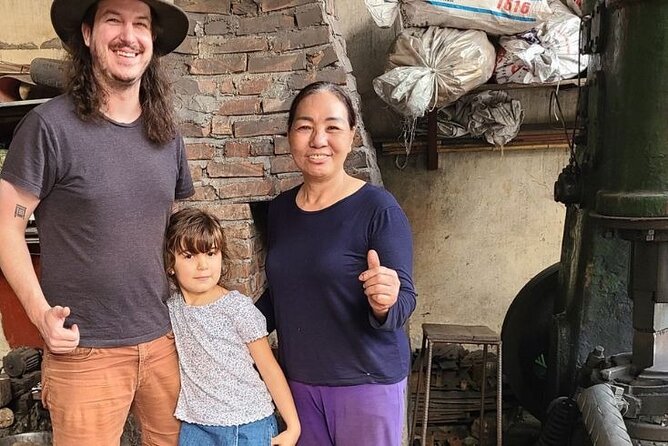
The workshop is not presented as a large commercial attraction. You meet local makers and have a chance to chat with them. One family member explains that people in the trade may start learning as young as 12, which helps explain the precision you see in the work. This is a skill taught through years of repetition, not a quick craft activity designed only for tourists.
Sketching the blade before the fire
Your knife begins with a simple design. You sketch the shape of the blade onto a sheet of durable metal. This first step gives you some control over the finished object, though the available information does not specify how many shapes or sizes you can choose.
That is worth clarifying if the size of the knife matters to you. One account of the class indicates that the family lets participants choose the size of their blade, but the precise options are not listed. Ask the guide what is practical for the session before the metal is cut.
The design stage also shows why a handmade knife is not simply a piece of metal with an edge. The blade shape, the tang, and the handle all need to work together. Even a basic cooking knife requires decisions about proportion and use.
Cutting the iron and working at the anvil
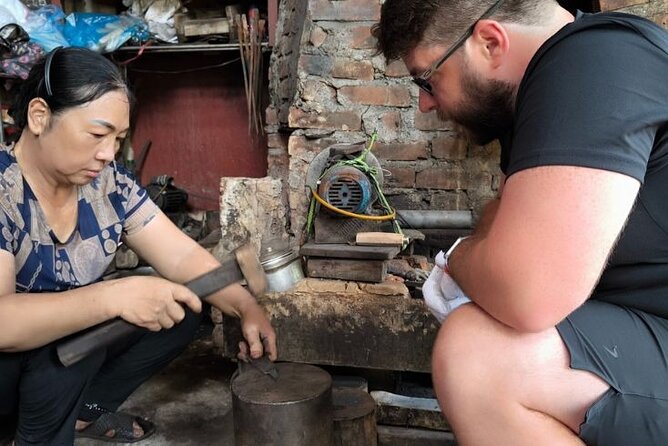
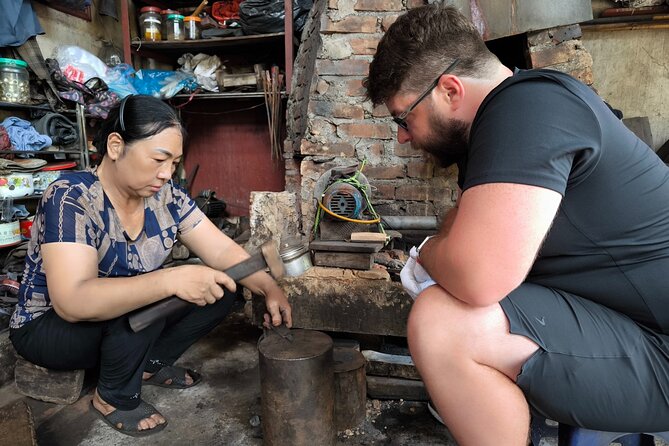
Next comes the part most people picture when they hear blacksmithing. With a hammer, cutter, and anvil, you cut out the blade and the tang, the narrow section that extends into the handle. The metal then goes into the hot coals.
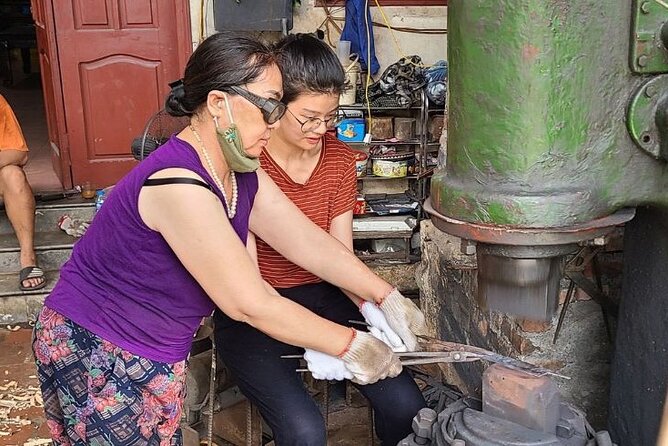
This is where the workshop becomes properly physical. You are not expected to master blacksmithing in one afternoon, but you do alternate blows with the maker as the hot metal takes shape. The timing matters. The force matters. A poorly placed strike can leave the metal uneven, so the local maker remains central to the process.
The family’s experience is especially valuable at this stage. A beginner can swing a hammer, but an experienced maker knows how to read the metal and correct its shape. The class lets you contribute without pretending that a few hours can replace years of work.
You should expect heat, noise, and repeated effort. The moderate fitness requirement is not decorative wording. If you have difficulty standing, hammering, or working with your hands for a sustained period, this may not be the right choice.
A different kind of day out, same stretch of Vietnam:
- Hanoi Jeep Tour: Food, Culture and Fun by Vietnam Army Jeep
★ 5.0 · 15,222 reviews - Full-Day Ninh Binh Highlights Tour from Hanoi
★ 5.0 · 7,761 reviews - Hanoi: Ha Long Bay Day Cruise – Swimming, Meal, Kayaking
★ 4.7 · 7,415 reviews - Hanoi: Water Puppet Show Tickets
★ 4.6 · 7,029 reviews
Trimming and correcting the blade
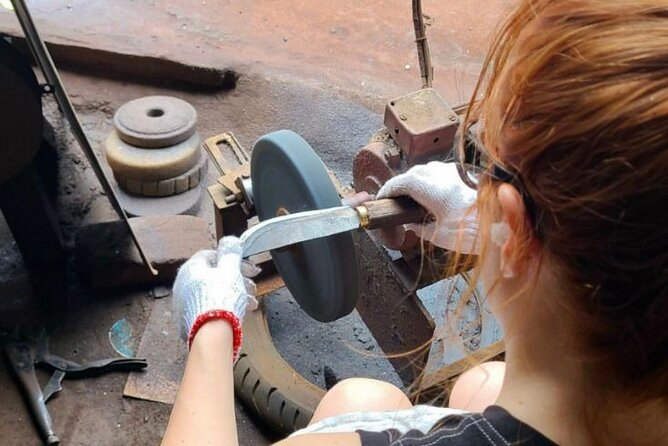
After the main shaping, imperfections are trimmed with a hydraulic cutting machine. This is an important practical detail. Your hammer work does not need to produce a flawless outline on its own, because the workshop has equipment for correcting the rough edges.
That makes the class more approachable for beginners. You still shape the blade and feel the work, but the final knife is not left entirely to chance. The process combines old methods, such as the anvil and hammer, with modern workshop equipment.
I would keep your expectations sensible. This is a lesson in making a simple knife, not a promise that you will produce a finely finished chef’s blade equal to a specialist’s work. The value is in seeing and helping with the full process, then leaving with an object tied to that process.
Sharpening on the grindstone
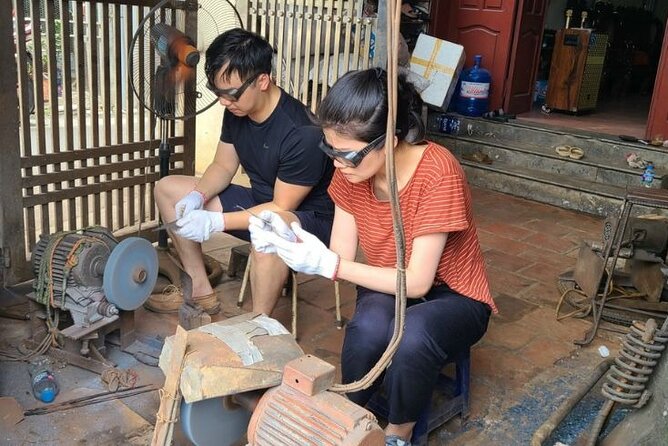
The final major stage is sharpening. The blade is worked on a grindstone through several phases, and it is soaked in a special tar-based chemical wash that the family keeps as a secret recipe.
That detail gives the workshop a strong local character. You are not just watching generic metalwork. The family has its own methods, including a treatment passed down within the workshop. You may not learn the full formula, but you do see that traditional craft includes closely guarded working knowledge.
Sharpening also demands care. The blade changes from a rough metal shape into a usable edge, but this is not the moment to rush. Follow the maker’s instructions closely and pay attention around the grindstone. The supplied information does not state how much of the final sharpening you perform yourself, so the maker may handle the most delicate part.
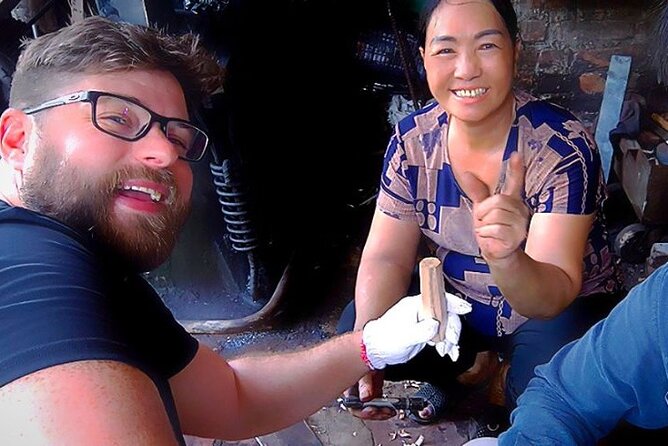
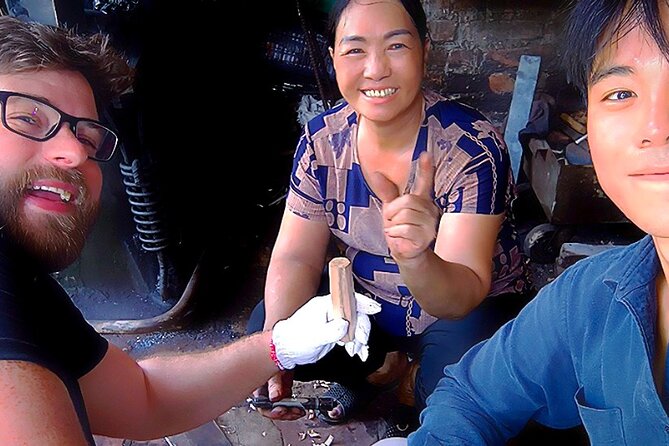
At the end, you take home the knife. It is an unusual souvenir, and that is part of its appeal. You can point to the blade and explain how you designed it, heated it, shaped it, and sharpened it in a Hanoi-area forging village.
The local family is the real heart of the visit
The equipment attracts attention, but the people make the visit worthwhile. You work alongside family members who have practiced forging for generations. Their role is not limited to supplying tools. They demonstrate the right technique, correct mistakes, and share a trade that remains part of village life.
The conversation can be as valuable as the hammering. You learn how the craft is passed from one generation to the next, including the fact that some people begin training in childhood. That gives context to the speed and control of the makers’ hands.
The class also offers a more grounded view of Vietnamese craft villages. These communities are not frozen displays of the past. They have made weapons, farming tools, and other practical items as needs changed. The workshop connects that long tradition to something you can understand directly: making a knife from metal.
An English guide helps bridge the language gap. Nathan is specifically associated with some sessions, but guide assignments may vary. If having him lead your visit matters, ask when booking rather than assuming he will be present.
What the $50 price includes
At $50 per person, the class is priced above a simple sightseeing stop, but it includes more than a short demonstration. You get the forging materials, an English-speaking guide, and an air-conditioned vehicle. Most important, you get about three and a half hours of instruction and practical work.
The iron material is included, so you do not need to buy supplies at the workshop. The finished knife is also the natural takeaway from the class. The exact handle materials and finishing details are not specified, so ask what is included in the final form of the knife.
The value is strongest if you want an activity rather than a passive visit. If you only want to buy a Vietnamese knife, a market or shop will be quicker and probably cheaper. If you want to understand how a tool is made and spend time with local makers, the price is more reasonable.
Lunch and tips are not included. Plan for those separately. Group discounts are available, which may improve the price for friends or family traveling together.
Who should book this workshop
I would recommend it to curious adults, older children who can follow instructions, cooks, craft fans, and anyone who wants a souvenir with a story. It suits people who enjoy making things imperfectly and learning by doing.
It is also a good choice if you have already seen Hanoi’s central sights and want time outside the usual city circuit. The village setting and family workshop offer a different pace from museums, temples, and Old Quarter shopping.
You may want to skip it if you dislike heat, noise, physical work, or close attention around tools. The class is not designed as a relaxed sightseeing stop. You will be involved in hammering, shaping, and sharpening, with the local makers guiding the more difficult parts.
The maximum group size is 10. That is a useful limit, but it does not guarantee private instruction. If you want the most personal attention, a smaller booking may be preferable.
Booking details worth knowing before you go
Confirmation is provided at booking. Pickup is offered, but the supplied details do not state exactly where pickup is available, so check the collection point and start time before paying.
The activity requires good weather. If poor weather causes a cancellation, you are offered another date or a full refund. It also requires a minimum number of participants. If that number is not reached, you are offered another date or experience, or a full refund.
You can cancel for a full refund up to 24 hours before the start time. Cancellations or changes made within 24 hours are not refunded or accepted. The cut-off uses Hanoi local time.
Wear clothing that lets you move comfortably. The supplied information does not list a dress code, but hammering and workshop work call for practical clothes rather than anything delicate or restrictive.
Should you book the Hanoi knife-making class?
Book it if you want a hands-on craft lesson with a real local family and an unusual souvenir. The strongest parts are the full process, the generations of forging skill, the small maximum group, and the chance to work with hot metal rather than simply watch it.
At $50, it is not the cheapest way to spend three and a half hours in Hanoi. It is a fair price for transport, materials, instruction, and a knife you help make. Just arrive ready for physical work, and confirm the pickup details, guide assignment, blade options, and final knife format before booking.
FAQ
Where does the knife-making activity take place?
It takes place in Hanoi and visits a traditional craft village on the outskirts of the city, known for its forging profession.
How long does the workshop last?
The activity lasts approximately 3 hours and 30 minutes.
What will I do during the class?
You sketch a blade, cut the blade and tang, heat the metal, help shape it with a hammer and anvil, trim imperfections, and take part in the sharpening process.
Is transportation included?
Yes. An air-conditioned vehicle is included, and pickup is offered.
Is an English-speaking guide provided?
Yes. An English tour guide is included. Nathan has led some sessions, but the assigned guide may vary.
How many people can join the class?
The activity has a maximum of 10 participants. Group discounts are available.
Is lunch included in the price?
No. Lunch is not included. Tips are also not included.
Can I cancel for a full refund?
Yes. You can cancel at least 24 hours before the experience start time for a full refund. Cancellations made within 24 hours are not refunded, and changes within that period are not accepted.
Recently reviewed around Hanoi
- Female Riders Vespa Night Street Food + Train Street food 4 Hours★ 5.0 · 35 reviews
- Beautiful Female Riders Vespa Red River Countryside Tour 5 Hours★ 5.0 · 23 reviews
- The insider’s Hanoi 4.5 hours All highlight Places & Train Street★ 5.0 · 41 reviews
- The insider’s Hanoi + Train Street 4,5 Hours Female Ao Dai Riders★ 5.0 · 53 reviews
- Red River Delta Countryside+ Rural Villages, rice Paddies fields★ 5.0 · 134 reviews
- Street Foods Hanoi Kim Tours Vietnam★ 5.0 · 140 reviews
- Hanoi Jeep Tour – Ba Vi National Park Full Day Tour★ 5.0 · 21 reviews
- Ninh Binh Full Day Tour from Hanoi to Hoa Lu, Trang An & Mua Cave★ 5.0 · 31 reviews
Workshops, compared.

Hanoi Cooking Class: Culture, Local Market & Meaning CSR Impact
Read our review →
5 Traditional Dishes Hanoi Cooking Class with Market Trip
Read our review →
Vietnamese Coffee Culture and Coffee Making Class
Read our review →

Cooking Class Hoi An:Local Market, Basket Boat, Fishing & Cooking
Read our review →
Hoi An Cooking Class(Market,BasketBoat Crabfishing&Cooking Class)
Read our review →
Hoi An Full Lantern Making Class- A special Foldable lantern
Read our review →
Cai Be Mekong Delta Tour: Cooking Class, Cycling & Craft Villages
Read our review →Browse the lists this tour appears in