
Reviewed · HOI AN TOURS
Hidden Gems of Old Hoi An
Hoi An’s best food stories often begin far from its lantern-lined main streets. This walk leads you through narrow lanes to family workshops where Cao Lau noodles and mung-bean sprouts are still made by hand, then serves the finished foods in local cafés, markets, and eateries. The production visits give the meal real context.
I like the early start, especially in hot weather, when you see Hoi An moving at local pace before the larger crowds arrive. I also like the small size, capped at 10 people, and guides such as Kiwi, Quyen, Kim, and Quynh, who explain family customs, trade, architecture, and food in an easy, personal way.
The main consideration is the walking. You need moderate fitness, and the route includes alleys, market areas, and busy road crossings. The schedule can also vary by morning or afternoon departure, so the early tour is the better choice if you want cooler air and a quieter town.
In This Review
- Key points at a glance
- Why the backstreets tell Hoi An’s food story
- Starting with coffee and a quieter Hoi An
- Inside the Cao Lau noodle workshop
- Seeing how mung-bean sprouts are grown
- Markets, temples, alleys, and old influences
- Five to seven tastings, not just one large meal
- What the small group changes
- Price, pickup, and meeting points
- Which departure and guide style suit you
- Who should book this Hoi An food walk
- Should you book Hidden Gems of Old Hoi An?
- FAQ
- How long does the Hidden Gems of Old Hoi An tour last?
- Is the tour offered in the morning and afternoon?
- How many food tastings are included?
- What foods and producers do you visit?
- Does the tour include hotel pickup?
- Where does the tour start and finish?
- How large is the tour group?
- How physically demanding is the walk?
- Can I cancel for a full refund?
Key points at a glance
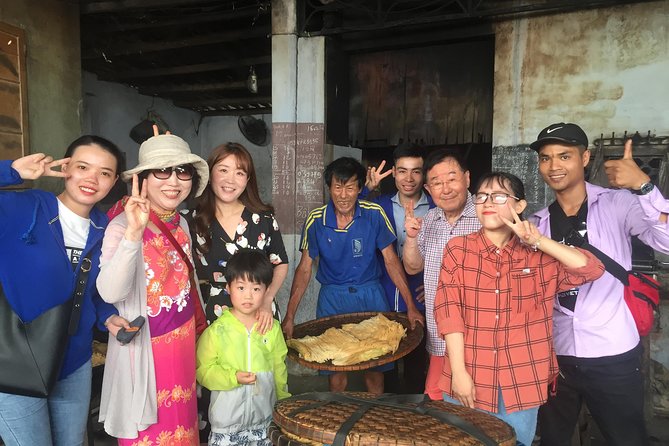
- Handmade Cao Lau noodles: Visit the oldest remaining noodle workshop mentioned in the tour, then taste the local specialty.
- Mung-bean sprout production: See how a family business grows and prepares bean sprouts by hand.
- Five to seven tastings: Food, bottled water, and coffee or tea are included in the tour price.
- Backstreet Hoi An: Walk away from the main tourist lanes through family courtyards, alleys, markets, and local neighborhoods.
- Small groups of up to 10: The format allows more time for questions and closer contact with the people you meet.
- Morning or afternoon choice: Early departures offer cooler conditions and a glimpse of daily life before the town fills up.
Why the backstreets tell Hoi An’s food story
The old center is easy to admire from the main lanes, but that view is only part of Hoi An. The town’s character also lives behind shopfronts, in family homes, small workshops, neighborhood markets, and places where food is prepared for local tables rather than for display.
This walking tour is built around that less polished side of town. You are not simply shown a plate of Cao Lau and told it is special. You see one of the families involved in producing the noodles, learn how the work is done, and then taste dishes that use the ingredients you have just encountered.
That structure makes the food more memorable. You connect the dish to a person and a process, not just to a restaurant menu. It also gives your guide something useful to explain: why particular foods matter in Hoi An, how family businesses survive, and how the town’s Chinese, Japanese, and Western influences have shaped local cooking and daily life.
The route is not presented as a formal lecture. Guides including Kiwi, also identified as Quyen, Kim, Quynh, Van, Emily, and Lien Lien are praised for mixing facts with personal stories and practical help. Guide assignments can change, but the experience is clearly designed around local hosts rather than a distant audio script.
Other Hoi An days travellers weigh against this one:
- Hoi An: Basket Boat Ride in the Coconut Forest
★ 4.9 · 4,956 reviews - Hoi An: Vietnamese Coffee Culture and Coffee Making Class
★ 4.9 · 4,006 reviews - Hoi An: Vietnamese Foldable Lantern Making Class
★ 4.9 · 3,742 reviews
Starting with coffee and a quieter Hoi An
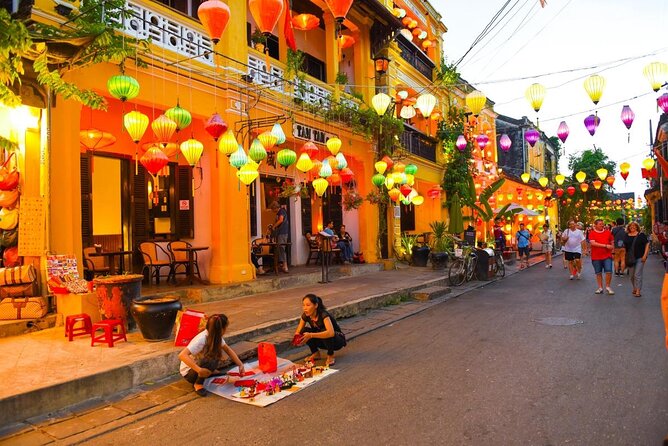
The early morning option is the smart pick if you dislike heat or want to see the town before its main streets become busy. One reported route begins with coffee at a local café, followed by a walk through streets and alleys that most first-time visitors would not find on their own.
Coffee or tea is included, and bottled water is provided. These are small details, but they matter in a three to four-hour walk. Hoi An can feel hot even when the route itself is not strenuous, and a drink at the start gives you time to meet the guide and settle into the group.
You should not expect a silent, empty town. Hoi An is a working place, and the morning route shows ordinary movement as well as old buildings. That is the point. You may see shops opening, people preparing food, and market activity before the day’s sightseeing rush gets going.
The afternoon departure suits people who prefer a slower start or have already spent the morning at another attraction. It may not offer the same cool conditions or early-market atmosphere, so I would choose based on the weather and your schedule rather than assuming the two time slots feel identical.
Inside the Cao Lau noodle workshop
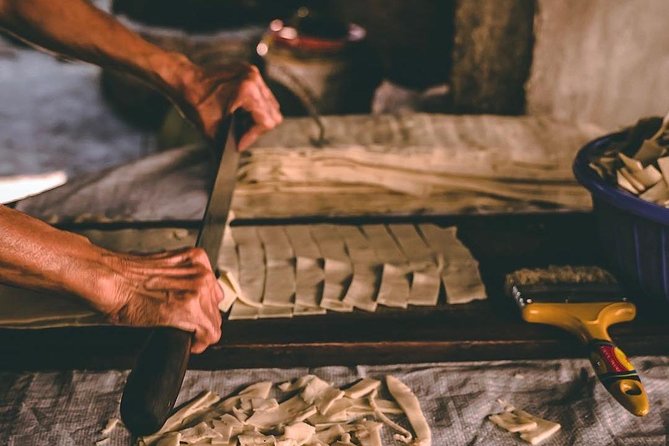
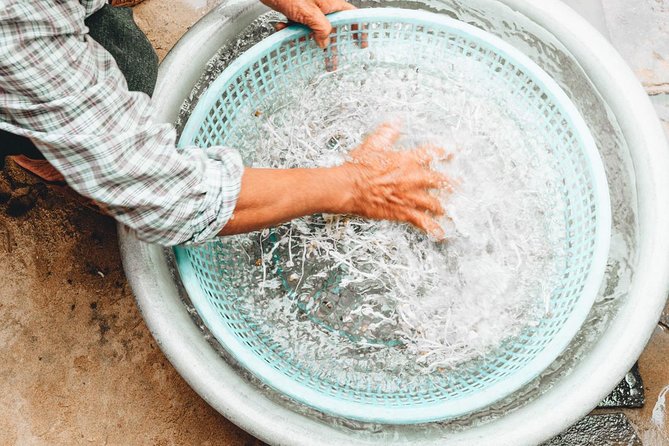
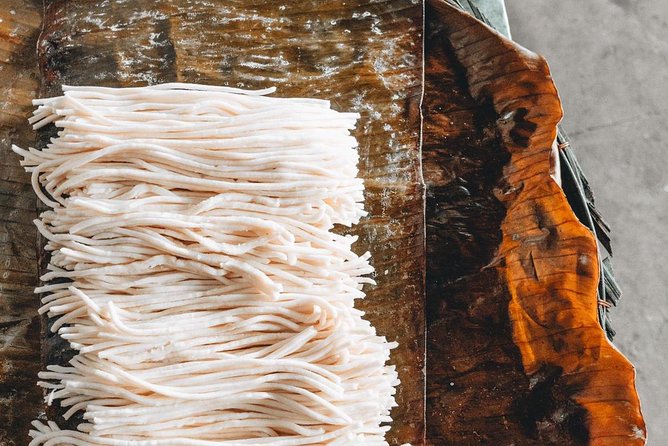
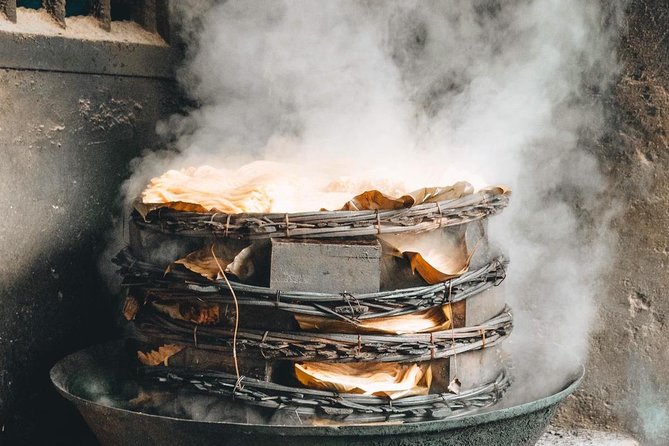
The Cao Lau stop is one of the strongest parts of the tour. You visit a local family producer, described as the oldest remaining factory of its kind on the route, and see how the noodles are made. The setting is more useful than a standard cooking demonstration because it shows food production as a working family trade.
Cao Lau is closely tied to Hoi An, and the noodles are central to one of the town’s signature dishes. Here, you get a look at the skill and routine behind them before encountering the food later in the tasting portion.
The word factory may sound large, but the experience described is much closer to a small family operation. That is good news if you want a close look at traditional work, though it also means the setting may be basic rather than polished. You are visiting an active local business, not a purpose-built attraction.
Your guide helps bridge the language and cultural gap. This is useful when you want to ask how the noodles are produced, who in the family handles the work, and how long the craft has been passed down. The exact demonstration can depend on what is happening that day, but the point is to see the process in its local setting.
Seeing how mung-bean sprouts are grown
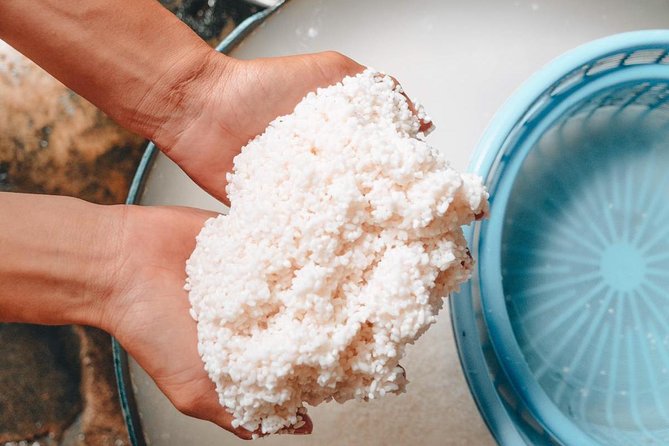
The bean-sprout visit adds a different kind of lesson. Instead of a finished specialty food, you see how a simple ingredient is produced by a local family. The process helps explain why everyday Vietnamese cooking depends so heavily on fresh ingredients prepared close to home.
This stop is valuable precisely because it is ordinary. A grand monument tells you about public history. A small producer tells you about household work, local supply, and the practical side of eating in Hoi An.
You will have a chance to taste the sprouts like a local, then encounter ingredients from the visits in dishes later on. That progression gives the tour a clear rhythm: meet the makers, see the work, walk through the neighborhood, then eat.
Expect a genuine working environment rather than a staged performance. The tour description focuses on family businesses that produce and sell goods in Hoi An, and the strongest part of the visit is the contact with people who still do the work. If you prefer only restaurant dining, this stop may feel less exciting. If you like knowing where food comes from, it is a useful addition.
A different kind of day out, same stretch of Vietnam:
- Cooking Class Hoi An:Local Market, Basket Boat, Fishing & Cooking
★ 5.0 · 3,660 reviews - Hoi An Cooking Class(Market,BasketBoat Crabfishing&Cooking Class)
★ 5.0 · 3,386 reviews - Hoi An: My Son Sanctuary Early Morning w. Champa Food Brunch
★ 4.9 · 2,750 reviews - Hoi An/ Da Nang – Ba Na Hills – Golden Bridge Deluxe Small group
★ 5.0 · 2,613 reviews
Markets, temples, alleys, and old influences
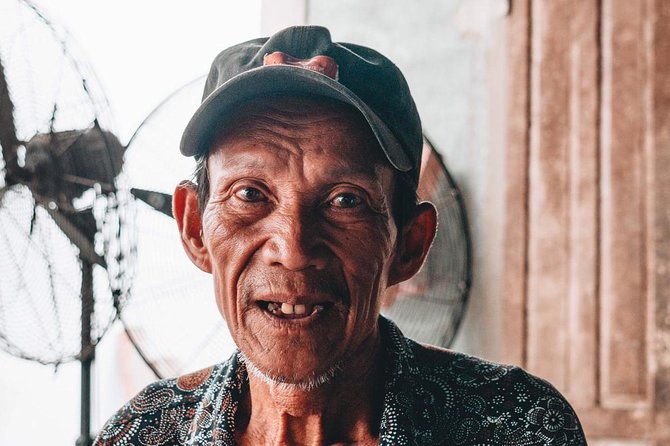
After the food-production visits, the walk continues through local routes toward a market, a family temple, and examples of Hoi An architecture. These stops widen the tour beyond food.
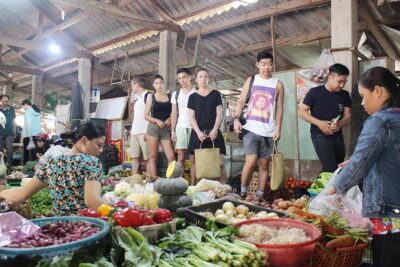
The market gives you a look at ingredients and local shopping habits. It also makes the later tastings easier to understand, since you have already seen the kind of produce that supports the town’s cooking. Market conditions can be lively, and you will need to stay close to the guide and watch your footing.
The family temple adds a cultural layer. You learn about local traditions and the role of family ties in community life. The route is not just a list of monuments. Guides explain how people live, work, worship, and maintain connections within the old town.
Hoi An’s past is shaped by contact with Japanese, Chinese, and Western communities, and the guide explains how those influences appear in architecture and cuisine. This is a strong reason to take the walk early in your Hoi An stay. It helps you recognize details later when you explore on your own.
A practical note: the Ancient Town stop is listed as about 20 minutes, with admission not included. The supplied tour details do not spell out a separate entry arrangement, so check the booking information if you are concerned about any town-ticket requirement on your date.
Five to seven tastings, not just one large meal
The tour includes five to seven tastings, which is enough variety to make the food portion feel like a full introduction rather than a single snack stop. You may eat at local cafés, small eateries, and market locations, with the exact dishes depending on the route and what is available.
The appeal is range. You get to try food connected to the producers you visited, along with local specialties and street food. One route includes tastings at Tiger Market, and the final stop is Bill Coffee & Tea at 22 Tran Hung Dao in Hoi An.
You should arrive hungry, but not so hungry that you rush the first stop. This is a walking food tour, not a restaurant lunch with one fixed course. Portions are spread across the route, and the guide can explain what you are eating and how it fits into local habits.
The food has received some of the strongest praise attached to the experience, but the useful point is not simply that there is plenty of it. The tour lets you try foods you might pass by because you do not know what they are or how to order them. A local guide makes that first step easier.
Dietary needs may be possible to accommodate, but you should raise them when booking. A vegan family group was accommodated, so the operation has shown flexibility, though the available substitutes should not be assumed without confirmation.
What the small group changes
The maximum group size is 10. That is small enough for questions without turning every stop into a crowd around a doorway.
A smaller group also matters at family workshops. You can hear the explanation, watch the work, and interact with the producer more easily than you would in a large food excursion. Guides have also handled families with young children, including children aged four and six, but the walking and road crossings still call for adult attention.
The pace is generally described as manageable for different ages and abilities, but the formal requirement is moderate physical fitness. You will spend three to four hours on foot, and the route includes narrow lanes and market streets.
Road crossings deserve particular care. One guide, Lien Lien, was specifically appreciated for helping the group across busy traffic. That is a practical part of having a local guide in Hoi An, where crossing can feel confusing if you are not used to the flow.
Price, pickup, and meeting points
At $41 per person, the tour is not the cheapest way to eat in Hoi An. You could buy several inexpensive local dishes for less. The value comes from combining food with access, interpretation, and a carefully linked route through places you would probably miss alone.
The price includes five to seven tastings, bottled water, and coffee or tea. Pickup is offered from select Hoi An hotels, but not every property is listed as eligible. The stated starting point is 03 Phan Dinh Phung, Cam Son, Hoi An, and the endpoint is Bill Coffee & Tea, 22 Tran Hung Dao, Minh An.
Some bookings have included hotel coordination by taxi, and communication through WhatsApp has been used for pickup details. Do not assume this applies to every hotel or booking. Confirm your pickup point before the start.
The tour has a mobile ticket and confirmation is issued at booking. It is near public transportation, but the main benefit is that the route finishes in the old town area, leaving you well placed for more sightseeing or a meal.
Which departure and guide style suit you
Choose the morning tour if you want cooler walking conditions, early market life, and quieter lanes. The six o’clock start used on some departures is especially appealing during hot periods, though you should confirm the exact start time when booking.
Choose the afternoon option if you prefer not to wake early or want to pair the tour with a morning at the beach or another attraction. The food and route remain the main draw, but afternoon heat and street activity may make the walk feel busier.
Guides have different personalities, yet the recurring strengths are clear. Kiwi, Quyen, Kim, Quynh, Van, Emily, and Lien Lien are described as warm, clear, attentive, and good with both adults and children. One guide even arranged a birthday cake, while the local representative Harry provided a printed tour photo and a small reed-woven snack bag on one occasion.
Those personal touches are not guaranteed, but they show the kind of host-led approach used here. You get help crossing roads, explanations about local customs, and room to ask questions rather than being pushed from one photo stop to the next.
Who should book this Hoi An food walk
I would recommend it to first-time visitors who want a useful introduction to Hoi An’s food and local life. It is also a good choice if you have limited time and want history, architecture, markets, family production, and tasting stops in one outing.
Food lovers will get the most from the Cao Lau and bean-sprout visits, especially if you enjoy seeing traditional work rather than only eating the final dish. Families can consider it too, since young children have joined successfully, but parents should be ready for walking and traffic.
This is less suitable if you want a formal cooking class, a seated multi-course meal, or a short sightseeing loop with little walking. It is also not the right pick for anyone who needs a completely fixed route and menu. The charm comes partly from visiting working local businesses, where conditions can change.
Cancellation is free up to 24 hours before the start for a full refund. Changes or cancellations inside that window are not accepted, and poor weather may lead to a new date or a full refund.
Should you book Hidden Gems of Old Hoi An?
Book it if you want to understand why Hoi An food tastes the way it does, not simply photograph a bowl of noodles. The family workshops, back lanes, market visit, and five to seven tastings give you a strong mix of food and everyday culture for a half-day outing.
I would choose the morning slot, arrive ready to walk, and confirm hotel pickup and dietary needs in advance. At $41, the tour earns its price through access to local producers and the guide’s explanations. If you prefer independent eating and already know Hoi An well, you may find it less necessary. For most first-time visitors, it is a thoughtful way to get beyond the main streets.
FAQ
How long does the Hidden Gems of Old Hoi An tour last?
The tour lasts approximately three to four hours.
Is the tour offered in the morning and afternoon?
Yes. You can choose a morning or afternoon departure. Early morning is useful in hot weather and offers a quieter look at the town.
How many food tastings are included?
The tour includes five to seven tastings, along with bottled water and coffee or tea.
What foods and producers do you visit?
The route visits local family businesses that produce items such as Cao Lau noodles and mung-bean sprouts. You then taste dishes that use ingredients connected to the visits.
Does the tour include hotel pickup?
Complimentary pickup is offered from select Hoi An hotels. Confirm that your hotel is included and check the pickup details before the tour.
Where does the tour start and finish?
The stated starting point is 03 Phan Dinh Phung, Cam Son, Hoi An. The listed endpoint is Bill Coffee & Tea, 22 Tran Hung Dao, Minh An, Hoi An.
How large is the tour group?
The activity has a maximum of 10 people.
How physically demanding is the walk?
A moderate level of physical fitness is recommended. You will walk through backstreets, alleys, markets, and town streets, including road crossings.
Can I cancel for a full refund?
Yes, if you cancel at least 24 hours before the experience start time. Cancellations or changes made less than 24 hours before the start are not accepted for a refund, and poor weather may result in a different date or a full refund.
Recently reviewed around Hoi An
- Romantic Sunset Dinner Cruise in Hoi An★ 4.7 · 108 reviews
- Thanh Ha Village: Pottery Workshop with Locals★ 4.4 · 223 reviews
- Snorkeling Cham Island: Snorkeling Tour by Speed Boat★ 3.6 · 26 reviews
- Hoi An: Rural Cycling Tour to Village with Basket Boat Ride★ 5.0 · 174 reviews
- Private Car Hoi An to Hue Via Hai Van Pass, Lagoon & More★ 5.0 · 22 reviews
- From Hoi An: Day Tour of My Son Temples and Marble Mountain★ 4.8 · 44 reviews
- Market Tour – Cooking Class – Coconut Boat Riding★ 4.4 · 43 reviews
- From Hoi An: Marble Mountains and My Son Sanctuary Day Trip★ 4.7 · 209 reviews
Hoi An Tours, compared.

Vietnamese Coffee Culture and Coffee Making Class
Read our review →
Cooking Class Hoi An:Local Market, Basket Boat, Fishing & Cooking
Read our review →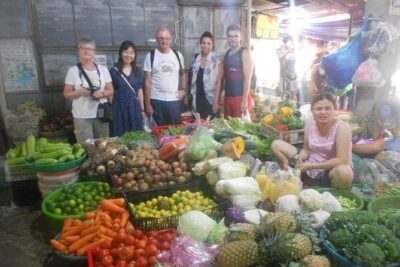
Hoi An Cooking Class(Market,BasketBoat Crabfishing&Cooking Class)
Read our review →
My Son Sanctuary Early Morning w. Champa Food Brunch
Read our review →
Hoi An/ Da Nang – Ba Na Hills – Golden Bridge Deluxe Small group
Read our review →
Hoi An Full Lantern Making Class- A special Foldable lantern
Read our review →Browse the lists this tour appears in