
Reviewed · HOI AN TOURS
Discover Traditional Silk Process in Hoi An Silk Village
The most revealing part of Hoi An Silk Village is the cocoon room, where a worker draws silk thread from cocoons and turns a small natural object into a long, fine strand. You also see the less comfortable truth: the traditional process kills the silkworm inside the cocoon. That honest look at production gives the visit more weight than a simple shop stop.
I like the short, focused route and the chance to see every major stage, from mulberry leaves to finished cloth. I also like the staff-led demonstrations, especially the weaving and spinning, and guides such as Thu and Tsu have been praised for clear English and patient answers. The main consideration is the small scale: the tour lasts only 50 minutes, and the fabric selection may feel limited or overly colorful if you are hoping for a large design range.
In This Review
- Key points at a glance
- Why the cocoon room is the heart of the visit
- Starting with Quang Nam’s mulberry story
- Walking through the mulberry garden and breeding house
- How a cocoon becomes silk thread
- Hand weaving and the Champa textile tradition
- Learning to tell pure silk from imitation
- Is $11 good value for 50 minutes?
- Guides, group size, and the pace of the visit
- Who will get the most from this silk village visit?
- Practical tips for a smoother visit
- Should you book the Hoi An Silk Village tour?
- FAQ
- How long does the Hoi An Silk Village tour last?
- What is included in the price?
- Where is the meeting point?
- Is hotel pickup included?
- Is the tour conducted in English?
- Can I buy silk products at the village?
- Is the tour suitable for wheelchair users?
Key points at a glance
- Silkworms from leaf to cocoon: See how mulberry leaves feed the worms and how cocoons are handled.
- Traditional Quang Nam setting: Hear how mulberry cultivation and sericulture developed in the region.
- Working textile demonstrations: Watch silk fibers become thread, then fabric, through manual methods.
- Champa and Dai Viet craft links: Learn how older regional textile traditions continue in the weaving house.
- A useful silk lesson: Compare pure silk with imitation fabric before deciding what to buy.
- A compact $11 visit: The 50-minute experience fits neatly into a Hoi An day, but it is not a full-day craft workshop.
Why the cocoon room is the heart of the visit
Hoi An Silk Village presents silk as a chain of work rather than a finished souvenir. You begin with the mulberry tree, move to silkworm breeding, then follow the cocoon through unraveling, spinning, weaving, and retail display.
That order matters. A silk shirt in a shop can look polished and anonymous. Here, you get a practical sense of the labor behind it. You see why good silk costs more than a synthetic imitation, and you can ask questions while the process is happening in front of you.
The cocoon extraction is also the most thought-provoking moment. Traditional silk production generally requires the silkworm to die inside the cocoon so the continuous filament can be collected. The experience does not hide that fact. If animal welfare is an important concern for you, this is worth knowing before you book.
The tour does not turn the subject into a technical lecture. It moves at a steady pace, with demonstrations and short explanations. That makes it a good choice if you want useful context without spending half a day in a museum.
Other Hoi An days travellers weigh against this one:
- Hoi An: Basket Boat Ride in the Coconut Forest
★ 4.9 · 4,956 reviews - Hoi An: Vietnamese Coffee Culture and Coffee Making Class
★ 4.9 · 4,006 reviews - Hoi An: Vietnamese Foldable Lantern Making Class
★ 4.9 · 3,742 reviews
Starting with Quang Nam’s mulberry story
After a welcome drink, the visit begins in a traditional house connected with craft sericulture in Quang Nam. This is where you get the local background: why mulberry growing mattered, how families supported silk production, and how the craft links the countryside with Hoi An’s textile trade.
The village is presented as a place that preserves valuable mulberry genetic sources as well as handmade silk-weaving methods associated with the Champa and Dai Viet eras. Those terms can sound grand in a short visit, but the practical point is clear. You are seeing a living craft with regional roots, not only a modern showroom arranged for tourists.
The old weaving factory adds useful context. It helps you understand that silk production depends on several connected skills. Growing mulberry trees is one job. Raising healthy silkworms is another. Removing the filament, preparing the thread, dyeing or arranging it, and weaving the final cloth all require different hands.
I would pay attention here even if you are mainly interested in shopping. The explanation gives you a better basis for judging the products later. You learn that a finished piece reflects more than color and pattern. The fiber, weave, weight, and feel all matter.
Walking through the mulberry garden and breeding house
The next stop takes you outdoors to the ancient mulberry gardens, then into the silkworm-breeding house. This is one of the most useful parts for families and anyone who likes seeing food or materials at their source.
You learn how silkworms are fed, with mulberry leaves forming the essential food supply. The visit connects a simple garden crop to an intricate textile process. Without the trees, there are no worms. Without healthy worms, there are no cocoons. Without carefully handled cocoons, there is no usable thread.
The breeding house is not a polished fashion setting. It is a working production space, and that is part of its value. The focus is on cultivation and care rather than spectacle. You may find the pace calm and straightforward, which suits the 50-minute format.
Comfortable shoes and light, comfortable clothes make sense. The experience includes several different buildings and garden areas, and large bags or luggage are not allowed. The setting is not suitable for wheelchair users or people with mobility impairments, so consider the walking and access requirements before booking.
How a cocoon becomes silk thread
At the unraveling house, the guide explains how silk thread is removed from the cocoon. This is where the process becomes easiest to understand because you can watch the material change in real time.
A cocoon does not arrive as a ready-made strand for a tailor. It must be handled and unraveled so the filament can be gathered into thread. The guide can explain the traditional method, while the workers demonstrate the physical steps. Seeing the process gives you a better appreciation for the smooth feel of silk fabric.
This is also the point where the animal cost of traditional silk becomes plain. The silkworm does not simply leave the cocoon and carry on living. For people who have never thought about that part of silk production, the demonstration can be surprising. I would not skip it, but I would approach it with an open mind and a willingness to see the full process, not only the attractive final product.
The short duration works well here. You get the key idea without watching repetitive production for too long. If you want to learn advanced spinning, dyeing, or tailoring techniques, this visit will not go that far. Its job is to show the chain clearly.
A different kind of day out, same stretch of Vietnam:
- Cooking Class Hoi An:Local Market, Basket Boat, Fishing & Cooking
★ 5.0 · 3,660 reviews - Hoi An Cooking Class(Market,BasketBoat Crabfishing&Cooking Class)
★ 5.0 · 3,386 reviews - Hoi An: My Son Sanctuary Early Morning w. Champa Food Brunch
★ 4.9 · 2,750 reviews - Hoi An/ Da Nang – Ba Na Hills – Golden Bridge Deluxe Small group
★ 5.0 · 2,613 reviews
Hand weaving and the Champa textile tradition
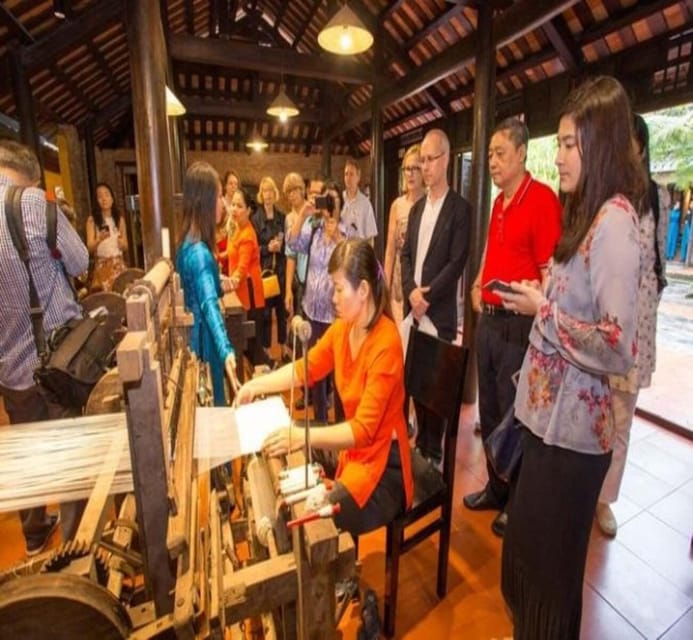
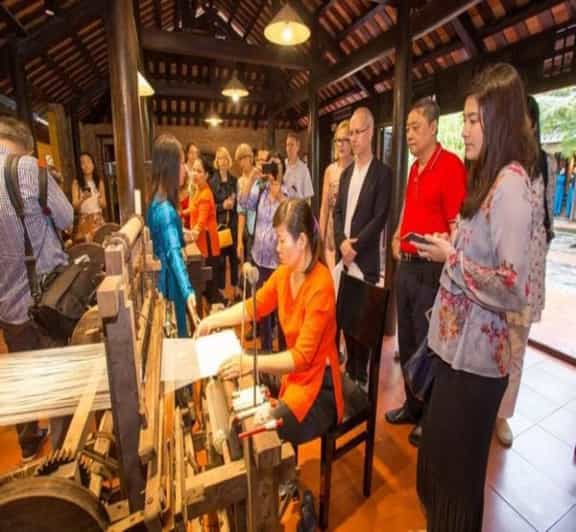
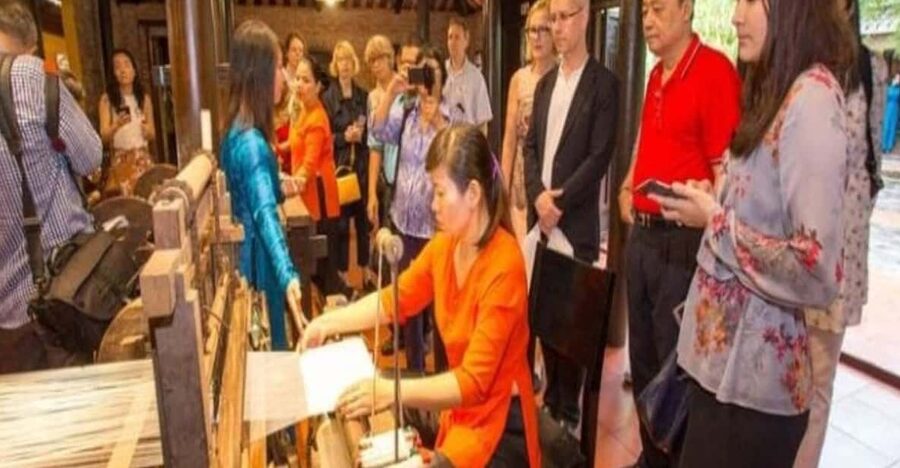
The traditional Vietnamese silk weaving house is where thread becomes cloth. You watch workers use manual methods to create fabric and learn about the handicrafts associated with Champa communities.
The appeal is in the movement of the work. Silk production is not just about a valuable fiber. The final character of the fabric depends on how the threads are arranged and woven. A demonstration makes this easier to grasp than a paragraph on a display board.
The Champa connection gives the stop a wider cultural frame. The experience links textile making to the people and traditions of Central Vietnam, rather than treating silk as a generic Asian souvenir. It also explains how handmade methods from the Champa and Dai Viet period remain part of the village’s identity.
The weaving house is likely to interest you most if you enjoy practical craft. You can ask questions about the tools, the thread, and the cloth, and guides including Thu have been noted for taking time with questions. The rooms can be limited in size, so a small group is an advantage. When school groups or other visitors are present, the timing may shift, as happened during one visit when the start was delayed by arriving students.
That kind of delay is not a normal part of the advertised 50-minute schedule, but it is sensible to leave a little breathing room around the appointment if your Hoi An day is tightly planned.
Learning to tell pure silk from imitation
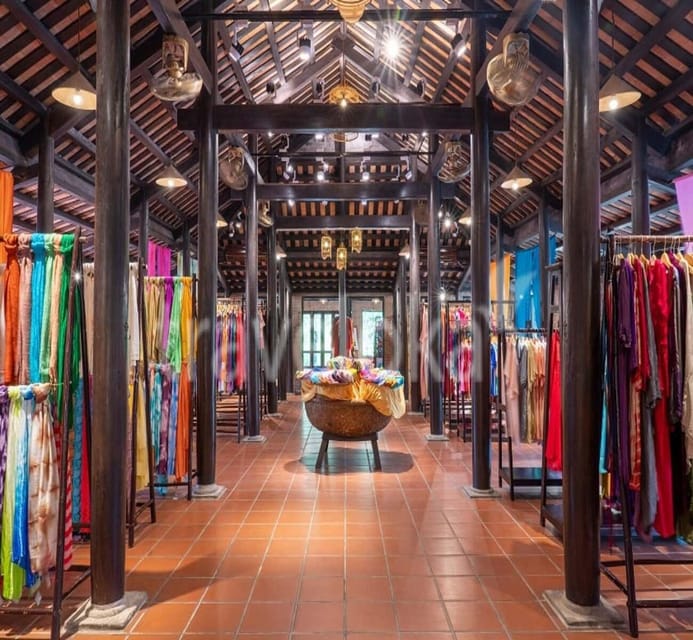
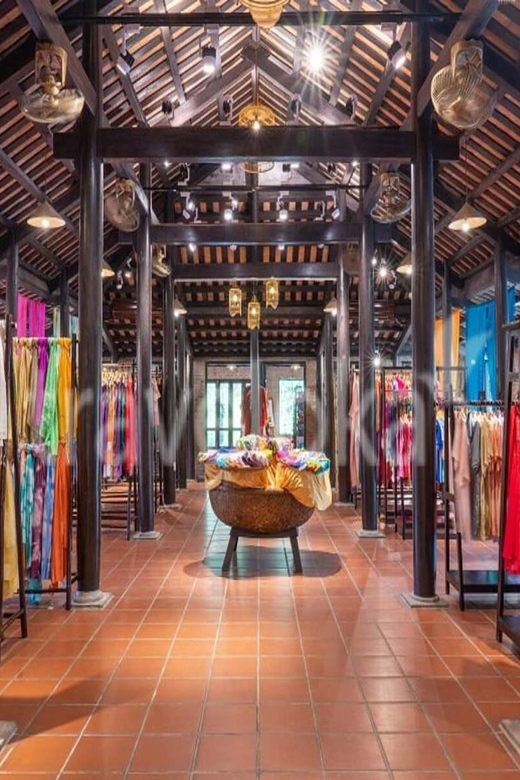
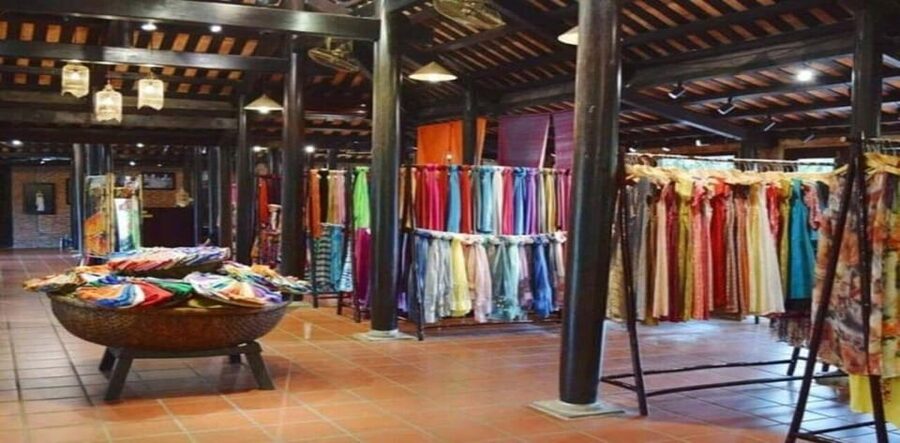
The final stop is the silk village exhibition and shop. This part serves two purposes. It shows finished products, and it explains how to distinguish pure silk from fake or synthetic fabric.
That lesson is valuable because silk shopping in tourist towns can be confusing. You may see shirts, scarves, fabric lengths, and other products in a range of prices. The guide gives you a better starting point for judging what you are being offered, instead of relying only on a glossy label.
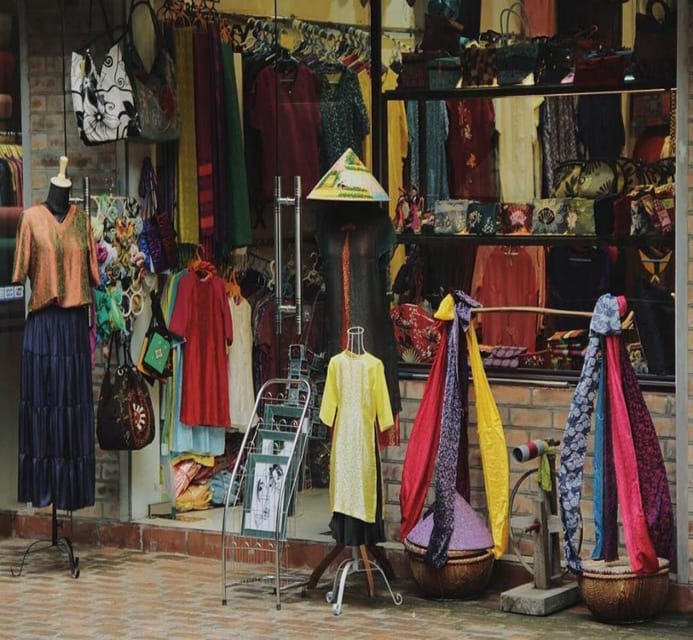
The shop includes items for personal use, gifts, and tailoring. A silk shirt can be a substantial purchase compared with the $11 admission, so use the demonstration to ask sensible questions before buying. Consider the fabric’s feel, weight, finish, and stated composition. The tour can help you shop with more confidence, but it does not require you to purchase anything.
The product range may not suit every taste. One visitor found the print selection too messy in its color combinations and felt there were too few choices. If you want bold, highly decorative patterns, you may find something appealing. If you prefer quiet colors or a broad selection of modern designs, the shop may feel less satisfying.
On the other hand, the quality of some silk shirts has been praised, and one visitor who had not planned to buy one changed their mind after seeing the process. That is a useful way to approach the shop: learn first, inspect carefully, and buy only if the fabric and design work for you.
Is $11 good value for 50 minutes?
At $11 per person, this is an inexpensive add-on to a Hoi An itinerary. The price includes an English-speaking guide, entrance, and a bottle of water. It does not include food, personal spending, or transport to and from the village.
The value comes from the range of stops packed into less than an hour. You visit a traditional house, mulberry gardens, a breeding house, an unraveling area, a weaving house, and an exhibition. You also receive a short lesson in silk quality. A private or specialist textile course would cost and take more, but this visit gives you the basic framework at a modest price.
The 50-minute duration is both a strength and a limit. It is long enough to add real substance to your day and short enough to fit between Hoi An’s old-town sights, meals, and tailoring appointments. It is not long enough for extensive conversation at every stop, nor does it promise that you will make your own silk product.
If you want a gentle activity after a busy morning, the tour works well. There is also a cafe on site, giving you a place to pause before or after the visit. If you are traveling with a strict schedule, remember that the meeting point is at 28 Nguyen Tat Thanh in Hoi An, and you need to arrange your own way there.
Guides, group size, and the pace of the visit
The tour is conducted in English with a live guide. Thu and Tsu are two guide names connected with particularly strong experiences. Tsu has led a private visit when no other English-speaking participants were present, while Thu was praised for clear explanations and patience with questions.
Group size can affect the experience because some of the buildings are small. A group of five leaves more room to see the demonstrations and hear the guide. If school groups arrive, the village may be busier and the start time can be delayed.
The pace is generally relaxed rather than rushed. You move from one stage to the next, with enough time to understand the basic process. I would not expect a long sit-down seminar or a tailored textile consultation as part of the standard visit.
The rating of 4.4 from 60 reviews fits that picture: a consistently worthwhile short activity, with the strongest praise aimed at the guides, the clear silk-making explanation, and the quality of the demonstrations. The less enthusiastic points focus on timing and the limited or uneven shop selection, not on the central lesson.
Who will get the most from this silk village visit?
I would recommend it to anyone curious about how everyday luxury goods are made. It is especially useful if you plan to buy silk in Hoi An, since the explanation gives you a way to think about quality before you spend more money.
Families may like the visible stages of the process, though very young children may not enjoy the fact that the silkworm dies. The calm pace also suits people who want a low-key cultural stop rather than another crowded attraction.
Textile fans, photographers, and people interested in Central Vietnamese craft will find the most substance here. The combination of mulberry growing, sericulture, hand weaving, and Champa textile traditions gives the visit a clear local focus.
I would be more cautious if you have limited mobility, need wheelchair access, or dislike garden and workshop visits. The tour is not suitable for wheelchair users or people with mobility impairments. I would also skip it if you want a long, hands-on class in weaving or tailoring. This is an introduction and demonstration, not a practical workshop.
Practical tips for a smoother visit
Meet at 28 Nguyen Tat Thanh in Hoi An and give your name at reception to confirm the booking. Hotel pickup and drop-off are not included, so plan your own transport and allow enough time to arrive.
Wear comfortable clothes and shoes. Do not bring luggage or a large bag, since these are not allowed. Carrying only what you need will make the movement between the houses easier.
If shopping matters to you, visit the exhibition with a plan. First listen to the explanation about pure and imitation silk. Then examine the products without feeling obliged to buy. Prints and color combinations can be a matter of personal taste, and the available selection may not match what you had in mind.
Booking is flexible: you can cancel up to 24 hours before the activity for a full refund, and you can reserve now and pay later. Starting times vary, so check availability before committing the rest of your day.
Should you book the Hoi An Silk Village tour?
Book it if you want a short, affordable look at a real craft process and you are considering buying silk in Hoi An. The strongest reasons are the clear English guidance, the complete route from mulberry garden to finished fabric, and the chance to see traditional methods rather than only a retail display.
Think twice if you need step-free access, dislike the animal aspect of silk production, or expect a large boutique with endless patterns. The shop may have limited designs, and the visit can be affected by school groups.
For $11 and 50 minutes, I think it earns a place in a Hoi An schedule, especially on a day when you want something informative but not exhausting. Go for the process and the local craft story. Treat the shopping as an optional extra.
FAQ
How long does the Hoi An Silk Village tour last?
The tour lasts 50 minutes. Check available starting times when booking.
What is included in the price?
The $11 price includes an English-speaking guide, entrance fee, and a bottle of water.
Where is the meeting point?
Meet at 28 Nguyen Tat Thanh, Hoi An, Quang Nam, Vietnam. Give your name at reception to confirm the booking.
Is hotel pickup included?
No. Hotel pickup and drop-off are not included, so you must arrange your own transport to and from the meeting point.
Is the tour conducted in English?
Yes. The activity includes a live English-speaking guide. Guides named Thu and Tsu have led English-language visits.
Can I buy silk products at the village?
Yes. The exhibition includes silk products for shopping and tailoring needs, including silk clothing and fabrics. The visit also explains the difference between pure silk and imitation fabric.
Is the tour suitable for wheelchair users?
No. The experience is not suitable for wheelchair users or people with mobility impairments. Large bags and luggage are also not allowed.
Recently reviewed around Hoi An
- Romantic Sunset Dinner Cruise in Hoi An★ 4.7 · 108 reviews
- Thanh Ha Village: Pottery Workshop with Locals★ 4.4 · 223 reviews
- Snorkeling Cham Island: Snorkeling Tour by Speed Boat★ 3.6 · 26 reviews
- Hoi An: Rural Cycling Tour to Village with Basket Boat Ride★ 5.0 · 174 reviews
- Private Car Hoi An to Hue Via Hai Van Pass, Lagoon & More★ 5.0 · 22 reviews
- From Hoi An: Day Tour of My Son Temples and Marble Mountain★ 4.8 · 44 reviews
- Market Tour – Cooking Class – Coconut Boat Riding★ 4.4 · 43 reviews
- From Hoi An: Marble Mountains and My Son Sanctuary Day Trip★ 4.7 · 209 reviews
Hoi An Tours, compared.

Vietnamese Coffee Culture and Coffee Making Class
Read our review →
Cooking Class Hoi An:Local Market, Basket Boat, Fishing & Cooking
Read our review →
Hoi An Cooking Class(Market,BasketBoat Crabfishing&Cooking Class)
Read our review →
My Son Sanctuary Early Morning w. Champa Food Brunch
Read our review →
Hoi An/ Da Nang – Ba Na Hills – Golden Bridge Deluxe Small group
Read our review →
Hoi An Full Lantern Making Class- A special Foldable lantern
Read our review →Browse the lists this tour appears in